Essay format is two different things at once, and most students trip over the overlap. One meaning covers the page layout that a paper follows. The other covers how you organize ideas from the introduction to the conclusion. This guide treats both: essay format as a layout (fonts, margins, citations) and as a structure (thesis, body sections, conclusion). Every example is written for real student writing.
You will find a step-by-step writing workflow, an MLA vs APA comparison, a worked outline example, and a short FAQ. Use the table of contents to jump to the section you need.
Note: You can format an essay in MLA, APA, IEEE, Chicago, AMA, ASA, Bluebook, and Harvard styles. But a proper essay structure varies based on the task, the reader, and your instructor’s specific writing guidelines.
What Is Essay Format?
The essay format describes two things a student has to get right. The first is the layout: how the paper looks on the page. This covers the font, spacing, margins, page numbers, title page, in-text citations, and the reference list. The second is the structure: how the essay is organized as an argument, from the introduction through the main paragraphs to the conclusion.
Both senses of essay format matter. Weak layout loses presentation points. Weak structure loses argument points. The reader, whether a high school teacher or a college professor, uses both to judge the writing. Before you start writing, check the assignment sheet for the required style (MLA, APA, Chicago, or another), the word count range, and any writing guidelines specific to the course.
Common Essay Formatting Styles
The first decision in any essay format is which style you will follow. Most undergraduate courses use one of two styles: MLA or APA. The rest (Chicago, IEEE, AMA, ASA, Harvard, Bluebook) show up in specific disciplines and should only be used when the course or tutor requires them.
MLA Format
MLA is the most commonly used essay format in the humanities, introduced by the Modern Language Association. It is applied in liberal arts and social sciences, especially literature, languages, and cultural studies. Most high school and college students in the US and Canada use this style when writing essays. The current manual is the 9th edition. Key elements of the MLA essay format: a page header, parenthetical in-text citations, a works cited page, and Times New Roman 12pt body text.
Header
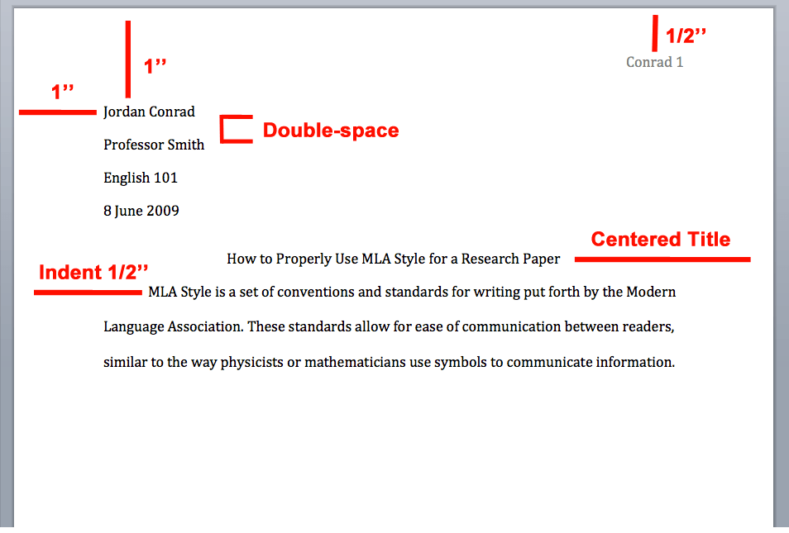
The MLA header, often called a running head, appears on every page, including the first page, with a half-inch margin at the top. It shows your last name followed by the page number. Some instructors may ask you to leave out one of these components, so check the prompt before you start writing.
First page details
The first page starts with your last name, the instructor’s name, the course title, and the submission date, all left-aligned. A title page is not mandatory in this style. If you include one, add a separate page with the essay’s heading and basic info. Ask your instructor first.
You can also use our title page generator to create a cover page and export it to Word or PDF. It supports both APA and MLA formats, and more styles are coming soon.
Works cited page
Begin your sources on a new page at the end of the paper and center the heading “Works Cited.” Follow the same formatting rules used for the rest of your essay. For each entry, indent the second line by an extra half-inch (a hanging indent). This page lets the reader verify every source in your argument.
Other requirements
After the heading comes the essay title, centered on the page. During essay writing, place the titles of other works in quotation marks or italics, and follow the rest of the formatting guidelines:
- Font: Times New Roman, 12pt font size
- Spacing: the text should be double-spaced throughout the paper, including the sources page
- Margins: one-inch margins on all four sides
- Indentation: indent each paragraph by half an inch (use the Tab key or configure it in paragraph settings)
- Page numbers: top right corner, next to your last name
- Title case: use title case for the main heading and for source titles on the references page
Page headers should appear on every page except for the cover page (if present). Put direct quotes in quotation marks when paraphrasing or citing an external source. You do not need to cite common knowledge. For details on quoting, see our guide How to Introduce a Quote.
APA Style
The next most popular essay format is APA, introduced by the American Psychological Association. Use it for papers in psychology, education, nursing, and the social sciences. The 7th edition is the current manual.
Header
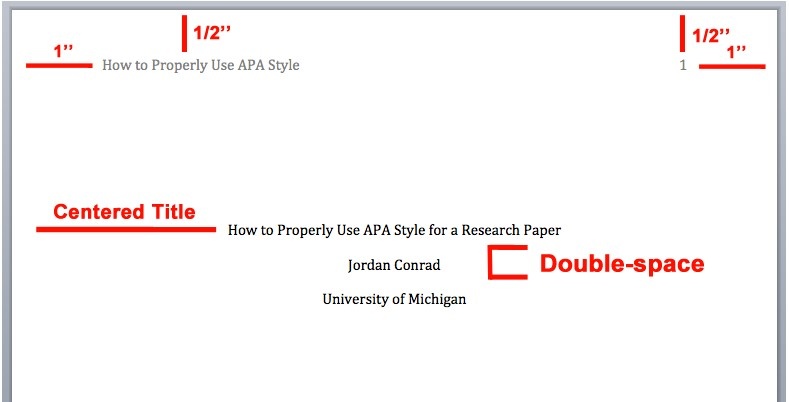
In an APA paper, a running head sits on every page in the upper left corner. This running head is a shortened version of your paper’s heading and cannot exceed 50 characters (including spaces and punctuation). Page numbers belong in the upper-right corner of every page.
Note: For a typical school or college essay, you are usually not required to include a running head. The page number alone is enough. Check the prompt before you add one.
The first page details
This style requires a dedicated title page. When created for a school paper, the cover page should contain:
- Title (centered, title-cased, and bolded)
- Author’s name (without degrees)
- Institutional affiliation
- Course name and number
- Instructor’s name
- Paper deadline
References
The references page parallels the “Works Cited” list used in the other style. Center the word “References” (bolded, without quotes) at the top. Use a half-inch hanging indent for each entry. Apply the rest of the style guidelines (double spacing, Times New Roman 12pt, or an equivalent accepted font). To learn about structuring entries and in-text citations, read the articles linked from the MLA section.
Other requirements
Major formatting guidelines for an essay in this style:
- Center the heading in the top half of the cover page
- Keep the title under 12 words and avoid fluff
- Place the page number in the top right corner of every page
- Double-space the entire essay, including the cover page and the reference list
- Keep the running head a short version of the full paper name
- Number and name all figures and tables (e.g., Table 1), with the name in italics above and an explanatory note underneath
No matter which essay format style you choose, always present the full list of sources used in your research and writing. The sources you cite are a core part of the argument, not an afterthought tacked on at the end.
MLA vs APA: Side-by-Side Comparison
The two most common essay format styles share a lot of layout conventions but differ in citation mechanics, heading style, and cover page requirements. The table below is a quick reference when you need to decide which rule applies. For a deep entry-by-entry comparison, see this APA Style and MLA Style References Comparison Guide (PDF).
| Element | MLA (9th edition) | APA (7th edition) |
|---|---|---|
| Primary discipline | Humanities, literature, liberal arts | Psychology, education, nursing, social sciences |
| Title page | Usually not required; info goes on first page | Required for a student paper |
| Running head | Last name + page number, top right | Shortened heading (≤50 chars), top left; page number top right |
| Font | Times New Roman 12pt (or similar readable font) | Times New Roman 12pt, Arial 11pt, Calibri 11pt, Georgia 11pt |
| Line spacing | Double spacing throughout | Double spacing throughout |
| Margins | One inch on all sides | One inch on all sides |
| In-text citation | (Author page), e.g. (Smith 24) | (Author, Year, p. page), e.g. (Smith, 2020, p. 24) |
| Reference list | Titled “Works Cited” | Titled “References” |
| Hanging indent | Half inch | Half inch |
| Heading structure | Flexible; author can decide | Five defined levels, strict formatting |
When the reader opens a paper, the in-text citation style is the fastest way to tell the two formats apart. MLA drops the year. APA puts it next to the author. Keep the distinction clear in every body paragraph and in the final reference list.
Other Essay Formats You Should Know
Beyond MLA and APA, several other essay format styles appear in specific disciplines. Most students will never use all of them, but recognizing them prevents panic when an instructor assigns an unfamiliar style.
AMA
AMA, established by the American Medical Association, is used in nursing programs, medicine, and health research. It uses superscript numbers for in-text citations and a numbered source list at the end. If your course is in medicine or a clinical field, AMA is the format to learn.
ASA
The American Sociological Association publishes ASA, a style close to APA with a few differences. It emphasizes the publication date and the author’s name in every in-text citation. ASA is standard in sociology, demography, and some anthropology journals.
Bluebook
Students studying law encounter Bluebook and McGill. Bluebook is a source-citation system with rules for legal professionals citing scholarly work. It was prepared by Harvard, Yale, and the University of Pennsylvania and is standard for most law review articles and legal briefs.
Chicago
The Chicago Manual of Style (CMS), often called Chicago style, is used in history, art, and many humanities journals. It is sometimes mistaken for Turabian (a simplified Chicago variant). The two main approaches are the Notes-Bibliography System (footnotes plus a bibliography) and the Author-Date System (parenthetical citations similar to APA).
IEEE
IEEE, developed by the Institute of Electrical and Electronics Engineers, is the required format for IT, engineering, and computer science. It uses bracketed numeric citations (e.g., [1], [2]) and a numbered source list in the order works appear.
Harvard
Harvard style is also known as the Author-Date reference style and is common in economics, business, and some sciences. There is no single official manual. Variants are published by the British Standards Institution and the Australian Government Publishing Service (AGPS). Many students find it easy to use because the rules are similar to APA.
That is not the full list. There are many citation formats to master, mostly to avoid plagiarism and to organize the paper properly. To make your life easier, use our Citation Generator tool to automatically create sources in the style you need.
How to Choose the Right Essay Format
Many students freeze at the first step because they do not know which essay format to use. The choice depends on three inputs: the discipline, the instructor’s requirements, and any journal or publication standard the assignment targets.
- Read the prompt first. Most professors state the required essay format in the first paragraph of the course instructions. If the prompt says APA 7, use APA 7. If it says “follow our standard course format,” check the syllabus.
- Match the discipline. If the prompt is silent, the default follows the discipline. Humanities and literature classes expect MLA. Psychology, education, and nursing expect APA. History classes expect Chicago. Engineering and computer science expect IEEE.
- Ask if you are unsure. A one-line email to your instructor is faster than guessing. “For this essay, should I use MLA or APA format?” gets an answer in a day.
- Check for journal or program overrides. Some programs (pre-med, law, specific graduate schools) override the discipline default. When in doubt, the program handbook wins.
Once you lock the format, stay consistent throughout the whole piece. Switching mid-draft is the most common writing mistake tutors flag during grading, and consistency keeps the reader focused on your ideas rather than format changes.
How to Format an Essay: Step-by-Step Workflow
This section walks through the actual process of formatting an essay from a blank file to a finished paper. Follow each step in order to avoid rework at the end. Each step combines layout work with writing decisions that support the overall argument.
Step 1: Set the page layout
Before you start writing the first paragraph, configure the file. Set one-inch margins on all sides. Set Times New Roman 12pt or the font your essay format requires (the style also accepts Calibri 11pt, Arial 11pt, and Georgia 11pt as alternatives for an APA paper). Set double spacing throughout the paper, including the cover page and the source list.
Step 2: Create the title page or first-page heading
For APA, create a proper title page with the paper’s title, author, institution, course, instructor, and due date. For MLA, put the name block at the top of the first page (your last name, instructor, course, date), then center the title below. The page header begins here and runs through the full paper.
Step 3: Write the introduction and thesis statement
Open with a hook that pulls the reader into the topic. Follow with two or three sentences of background that frame the subject. End with a clear thesis statement that previews your argument and the main points it will introduce. The thesis is the essential anchor of the whole essay, because every body paragraph must connect back to it in a sensible order.
Step 4: Write the main sections
Each body section presents one focused idea: a topic sentence, the evidence, an explanation, and a transition to the next paragraph. Keep the focus tight. If a paragraph tries to carry two ideas, split it. The reader should be able to follow the argument from one section to the next without backtracking, and each body section should move your writing one step closer to the conclusion.
Step 5: Write the conclusion
The final paragraph restates the thesis in new words, summarizes the main points of the body, and closes with a broader implication (so what, what next, why it matters). A strong conclusion leaves the reader with a memorable final idea rather than a flat summary.
Step 6: Add citations and the reference list
Insert in-text citations as you write. Retrofitting them at the end is slow and error-prone. When the draft is complete, compile the works cited or reference list. Double-check every entry: author, year, title, publisher, or journal. Use a citation tool if you have many sources.
Step 7: Proofread and run a formatting pass
Read the paper out loud to catch awkward sentences and weak ideas. Then run a dedicated formatting pass: font consistency, double spacing, margin check, page numbers, hanging indents, and title capitalization. This step is boring, but it saves you from losing points on details you already know. A slow proofread at this stage is the highest-leverage writing investment you can make before submission.
How to Structure an Essay (Outline)
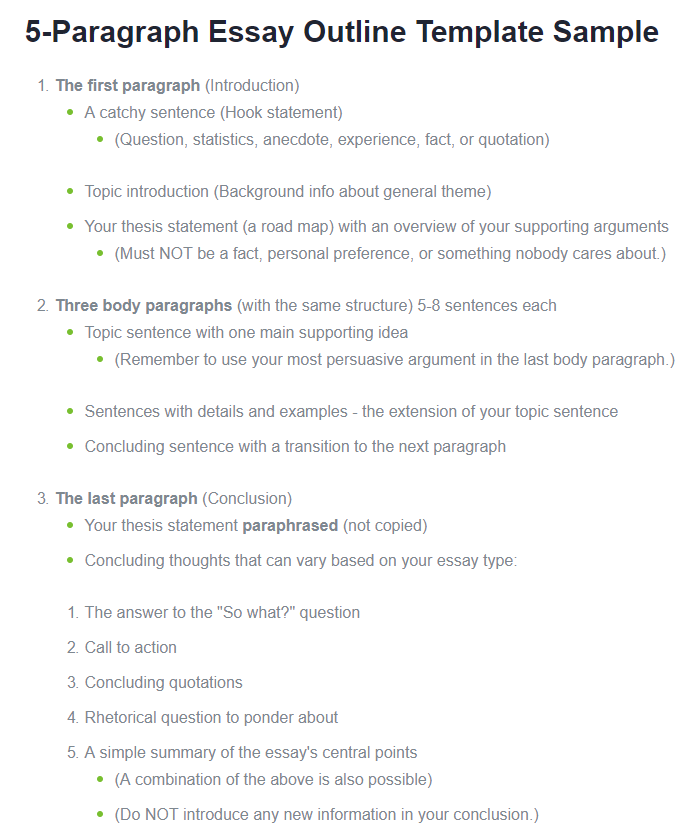
This section covers how your essay should be organized in its core parts and main points. A proper structure is one key to a high grade: it helps the reader follow the sense of your ideas from one paragraph to the next. A standard essay format at the structural level looks like this:
One introduction paragraph
The paper should start with an engaging opening that grabs the reader’s attention. Introduce the central argument in two or three sentences, then end the intro with a solid thesis statement. This is where you set up the whole essay and frame the ideas that the body will develop.
Learn more about this first part in our separate guide: How to Write an Essay Introduction.
Three body paragraphs
You usually have three main body paragraphs, each dedicated to one argument or claim that supports the thesis. There can be more if the task and word count allow, but consult your tutor before writing more than five main sections.
Each passage starts with a topic sentence that names the main idea. The topic sentence is followed by the evidence and its interpretation, then a transition sentence that introduces the next idea. Keep each passage to one focus. A reader scanning only the topic sentences should still understand the argument.
Read our comprehensive 12-step guide on essay writing to learn more about this part: How to Write an Essay.
One conclusion paragraph
The final segment is the conclusion, and it does more than summarize. It restates the thesis in new language, ties the main ideas back to the bigger question, and adds a forecast or call to action at the end. A good conclusion leaves the reader with a reason to remember the writing.
Find out how you can write this part in our article: How to Write a Conclusion for an Essay.
The source list
The source list is where both senses of essay format meet. It is a structural section (the last one), and it follows strict layout rules: hanging indent, alphabetical order, and a specific heading. Keep the source format consistent with the rest of the writing.
Note: This section, called Works Cited in MLA or References in APA, contains entries with full information about every source you used or cited (author’s first and last name, source title, year of publication, publisher, and location). Place the source list on a new page at the end of the paper.
For the structure of entries and citations themselves, check our article with examples: How to Cite an Article in an Essay (MLA and APA).
Whether you write a 1000-word essay or a 500-word term piece, stick to the general structure. The example below is a full walkthrough.
Essay Format Example (Outline)
Once you select your essay topic, the next step is to create an outline. If the prompt were about cultural identity, the outline could look like this:
Note: For more examples and tips for writing, check this guide: How to Make an Outline for an Essay.
I. INTRODUCTION
- Joke about culture to grab the reader’s attention
- Thesis statement: “My cultural identity had the greatest impact on my upbringing, education, and professional development.”
II. BODY
- A. First main paragraph
- Compare and contrast my cultural identity with my parents and peers
- Elaborate with specific detail
- Example from my kindergarten period
- B. Second main paragraph
- Internal and external cultural conflicts: their impact on my cultural identity and behavior
- Elaborate with specific detail
- Example from my middle school period
- C. Third main paragraph
- The elements of my cultural identity that define who I am today
- Elaborate with specific detail
- Example from my high school period
- III. CONCLUSION
- Paraphrased thesis statement
- Significance of my cultural identity and experience
- IV. REFERENCES
The academic image of a student partly depends on how well they follow the proper essay format. A clean plan shapes a focused argument before drafting and surfaces weak ideas early.
To avoid structure and format issues, review the assignment from your instructor, follow academic writing standards, and find templates online. A single hour of planning saves five hours of rewriting later.
College Essay Format Tips
A college essay (especially a college application essay) follows slightly different essay format rules than a standard academic piece. The college essay word count is usually shorter (250 to 650 words). The reader is an admissions officer, not a tutor grading an assignment. Structure matters more than citation mechanics, and the writing should focus on voice and fit.
- Keep the college essay personal. The reader wants to hear the student’s voice. Use first person and specific ideas from your own experience.
- Respect the word count. A 500-word college essay that runs 700 words will be cut in review. A 650-word Common App piece at 400 words looks thin.
- Use a clear structure. Hook introduction, two or three main sections on one theme, and a forward-looking conclusion. Not the place for five dense sections.
- Format for screen reading. Admissions readers go through dozens of college essays per hour. Short paragraphs and clean spacing help the reader stay engaged.
- Ignore research-paper fonts. Most college application essays are submitted through the Common App or a school portal, which decides the font for you.
Frequently Asked Questions About Essay Format
What is the standard essay format?
The standard essay format has two meanings. As a layout, the standard is Times New Roman, 12pt, double-spaced, one-inch margins, and page numbers. As a structure, the standard is a five-paragraph piece: an introduction with a thesis statement, three main sections, and a conclusion. Most high school and college writing follows both standards together.
What font should I use for an essay?
Times New Roman 12pt is accepted by every major essay format style. APA 7 also accepts Calibri 11pt, Arial 11pt, Georgia 11pt, and Lucida Sans Unicode 10pt. Unless the assignment specifies a different font, Times New Roman 12pt is the safe default for any student writing a college essay.
How long should each paragraph be?
Most paragraphs in an academic essay are between 100 and 200 words. A paragraph under 50 words often feels underdeveloped. A paragraph over 250 words usually contains two ideas and should be split. Think of each section as one claim plus the evidence that supports it, with the focus staying on one clear point.
Do I need a title page?
In APA, yes. A student piece in APA 7 requires a cover page with the essay name, author, institution, course, instructor, and due date. In MLA, no: the style uses a name block on the first page instead of a separate cover page, unless the instructor asks for one.
How do I cite in MLA vs APA?
MLA uses (Author page), for example (Smith 24). APA uses (Author, Year, p. page), for example (Smith, 2020, p. 24). The source list is titled “Works Cited” in MLA and “References” in APA. The underlying rule is that the in-text citation must point the reader to the matching entry on the source page.
What is double spacing?
Double spacing means each line of text sits on a line that is twice as tall as the text. In Microsoft Word, set the spacing to 2.0. In Google Docs, use Format > Line spacing > Double. Every major essay format style requires double spacing throughout the entire piece, including the source list.
How do I format the title of the writing?
In MLA, the title is centered on the first page in title case. Do not bold, italicize, or underline your own title. In APA, the title sits centered in the top third of the cover page, title-cased and bolded. Use a specific, focused title: bloated phrases like “An Essay About X” lose the reader.
Can I use the same format for every course?
No. The discipline and the instructor decide the format. A psychology course will expect APA even if you used MLA in English last semester. The safe workflow is to open the assignment, confirm the required essay format, and only then start writing. Consistency within a single paper keeps the reader focused on your ideas.
If you still have a question about essay format that this guide does not answer, reach out through our About page, and we will update this section.
Was this article helpful?

Written by
Terry is a Chicago-based writer and editor who creates practical, student-friendly guides on essay writing, research, and citation styles (APA, MLA, and Chicago). He’s spent 15+ years editing educational content and building clear examples that help readers apply rules without guessing. When he’s not revising drafts, he’s usually turning messy notes into clean outlines and hunting down the one detail everyone skips.