Choosing an essay title may feel like a small detail compared to researching sources, structuring paragraphs, and polishing your argument. Yet, the title is the first part of your work that people see. A compelling essay title can determine whether a potential reader—or even a busy professor—decides to engage further. In academic work, it shows how clearly you understand your topic and whether you can compress the argument into a few words. Outside academia, the title can mean the difference between someone skimming right past your work or pausing to read more deeply.
On a fundamental level, an essay’s title serves multiple functions. It orients the reader to the subject, provides insight into the content or angle, and can hint at the tone (formal, conversational, or playful). If the title fits, readers are more likely to give the rest of the text their time. If it misses the mark, whether through vagueness or wordiness, they may dismiss the essay before reading it.
There is a psychological side as well. A title sets an expectation: “This is what you’ll learn or experience if you read on.” An enticing yet truthful promise can maintain a strong bond between writer and reader, leading to higher satisfaction once the essay concludes. A misleading or clickbait-style title can leave readers feeling disappointed and distrustful of the content.
Finally, the exercise of titling is also a test of your own clarity. If you can distill your main argument or story arc into a phrase, you likely have a strong conceptual grasp of your paper. If you struggle, that could signal an underlying lack of clarity. Writers often find that finalizing the essay title demands they revisit their thesis and sharpen their focus. Choosing a title sharpens the essay as much as it sells it.
Understanding Your Essay’s Purpose
Before brainstorming a title, first assess what type of essay you’re writing and the intention behind it. Not all essays have the same goal, so what works brilliantly for a personal narrative might flop in a scientific research paper. Below are some common essay categories and how their purpose can influence titles:
- Persuasive or Argumentative Essays
In these essays, you aim to convince the reader of a particular stance or to take a specific action, so the title should signal the core argument or the issue under debate. For example, a persuasive essay about environmental policy might use a title that hints at urgency or necessity: “Turning the Tide: Why We Must Act on Climate Now.” The title tells readers an argument is coming. - Analytical or Expository Essays
These essays break down a topic or concept into understandable components, often focusing on interpretation or detailed explanation. Titles in this category should strive for clarity and specificity. Perhaps you’re dissecting a literary piece; a suitable essay title might read “Unraveling Symbolism in Shakespeare’s Macbeth: A Study of Guilt and Prophecy.” The reader immediately knows this essay will offer in-depth analysis rather than reflection or persuasion. - Narrative or Descriptive Essays
Personal stories, memoirs, or descriptive essays benefit from engaging, evocative titles. The title can reflect a theme, setting, or emotional undercurrent rather than an overt thesis. If you’re writing about a personal experience, a title like “Footprints on the Trail: My Summer in the Rockies” or “Echoes of My Ancestry: A Journey Through Cultural Memory” signals an emotionally rich story. - Research Papers
For a more formal or scientific piece, titles are plain and factual. Academic journals favor titles such as “A Longitudinal Study of Remote Work Productivity in Tech Startups.” While this may be much less flashy than the previous examples, it states the paper’s scope and method, which is what researchers skimming a database need. - Comparative Essays
If your goal is to examine similarities and differences, make it clear in your title. “Urban vs. Rural Healthcare: Comparing Accessibility and Outcomes” is an example that tells readers exactly what’s being contrasted.
Identify the essay’s purpose first, because it sets the tone for everything else. Once you know whether you should evoke a call to action, offer an analytical framework, or simply tell a story, you can shape your essay title accordingly. Understanding your purpose also helps you remain consistent; a highly playful title for a somber topic might mislead your audience, whereas a highly technical title for a personal reflection could feel off-putting.
How to Title an Argumentative, Persuasive, or Narrative Essay
This section explains how to title an essay for three of the most commonly assigned formats. The title of an essay works differently depending on what the essay is trying to do. An argumentative essay title should name the position you’re defending. A persuasive essay title should point toward the action you want the reader to take, using direct, active language rather than a neutral description. A narrative essay title should hint at the moment or theme the story turns on. If you’re wondering specifically how to title an argumentative essay, lead with your claim, not your topic, since the title should announce the position you’re defending before the reader opens the essay. The table below shows good titles for essays in each category that you can adapt for your own topic.
| Essay Type | Example Title |
|---|---|
| Argumentative | “Homework Overload: Why Middle Schools Should Cap Nightly Assignments at 30 Minutes” |
| Argumentative | “Screen Time Limits Won’t Fix Teen Anxiety, But Sleep Schedules Might” |
| Persuasive | “Vote Yes on Composting: How One Campus Program Cut Cafeteria Waste in Half” |
| Persuasive | “Give Every Student a Free Bus Pass and Watch Attendance Climb” |
| Narrative | “The Summer I Learned to Fail Out Loud” |
| Narrative | “Three Flat Tires and the Grandmother Who Taught Me Patience” |
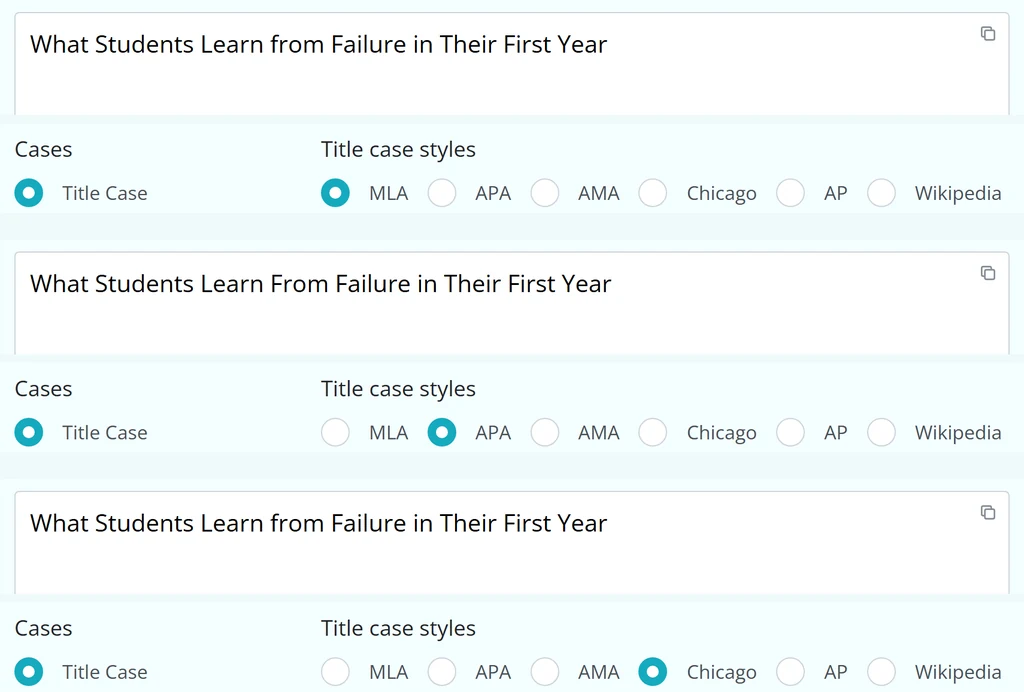
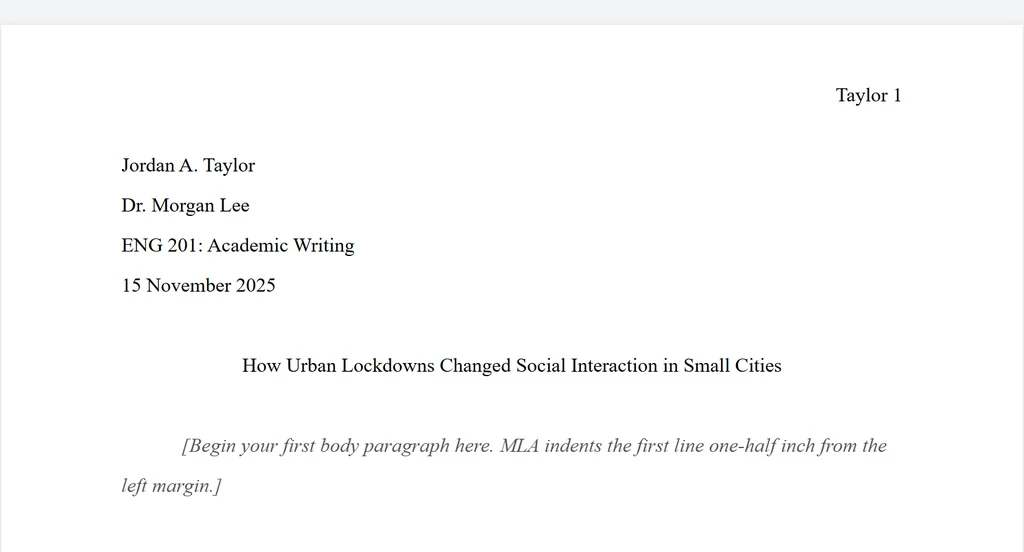
Capitalization follows the same rules across all three types. If you’re citing your paper in MLA style, lowercase short prepositions and conjunctions unless they open or close the title, then check the citation-style table below for how APA and Chicago handle the same words.
A strong essay title and a weak one are usually separated by specificity, not cleverness. Compare this contrast between two takes on the same argumentative essay:
The first title tells the reader your stance, your evidence, and your scope in one line. The second could describe almost any essay on the topic. First-time writers default to a broad topic phrase instead of a specific claim, which is the single most common mistake students make when titling an argumentative essay. When you’re stuck, ask what a reader would need to know to decide whether your essay is relevant to them, then work that into the title. Match your language to your audience: plain and direct for a class assignment, sharper for a contest or publication. That habit is the fastest way to write titles that actually get read.
Key Elements of a Good Essay Title
While there is no one-size-fits-all formula for the perfect title, a few criteria hold across disciplines and essay types. A title that meets them is more likely to reach readers and to describe the essay accurately.
- Clarity
First, make sure the title states the main topic or purpose. If your essay is about analyzing major themes of censorship in 20th-century dystopian literature, a vague title like “Hidden Messages” could be interesting but might not convey enough meaning. A clearer version could be “Hidden Messages: The Role of Censorship in 20th-Century Dystopian Literature.” This sets a direct expectation. - Relevance
A title that diverges from the actual substance of your essay risks irritating or misleading readers. If you imply that your essay is a data-driven study but deliver a purely opinion-based piece, people may feel deceived. Every word in the title should match what the essay delivers. - Brevity with Impact
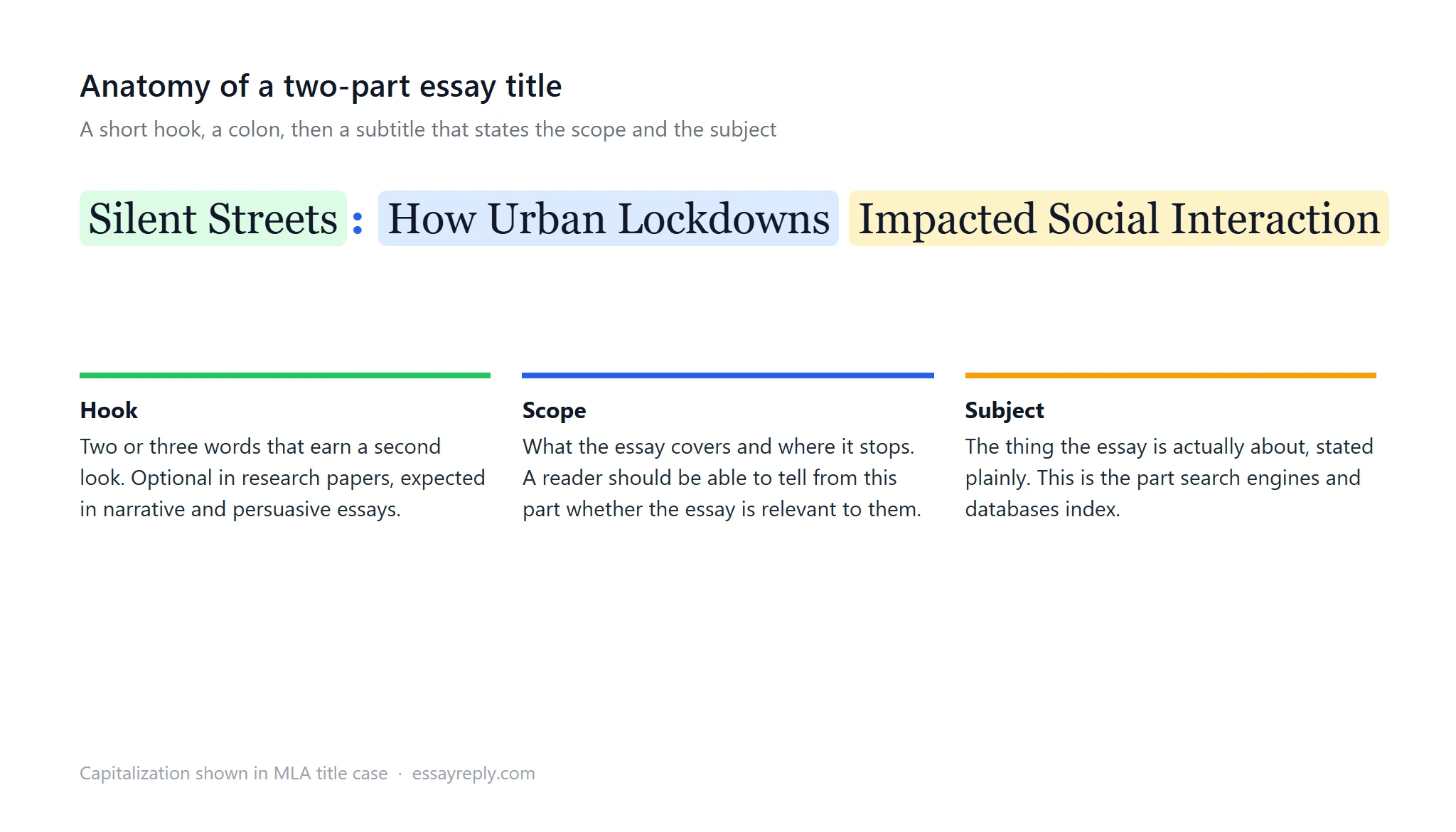
A concise essay title is easier to remember and cite, and it often hits harder. While short titles can be dramatic (“Silent Streets”), longer ones also work, particularly in academic essays, if they use a two-part format. For instance, “Silent Streets: How Urban Lockdowns Impacted Social Interaction” tells a story while maintaining clarity. - Specificity
Good titles often reveal the scope or angle of the essay. “Leadership in Business” is broad. “Transformational vs. Transactional: A Comparative Study of Leadership Styles in Tech Startups” is both specific and informative, immediately telling readers the essay’s central focus and context. - Originality and Hook
Especially in competitive or creative fields, a little originality helps. You might spark curiosity through a question: “Is Fast Fashion Slowing Our Future?” Or you could introduce a clever twist on a common phrase to show a fresh perspective. However, any creativity must still serve clarity.
When you pair clarity, relevance, brevity, specificity, and originality, you get a title that tells readers what the essay is and gives them a reason to open it.
Title Brainstorming Techniques
Coming up with a title can be tough. Six ways to generate candidates:
- Freewriting
Set a timer for five to ten minutes and list every word, phrase, or question that comes to mind regarding your essay’s topic. Don’t worry about grammar or order; just keep writing. It’s a liberating exercise that taps into raw creativity and can uncover angles you might overlook if you’re too focused on perfect phrasing from the start. - Mind Mapping
Begin with your central concept at the center of a page. Then, branch out subtopics: themes, arguments, key terms, and interesting anecdotes. From each branch, see if a potential title emerges. Mind mapping gives a visual structure to your thought process, allowing you to see connections that might lead to a concise, thematic essay title. - Keyword Analysis
Some essays (especially academic or web-oriented) benefit from including certain keywords in the title, either for clarity, search engine optimization, or to align with specific course or journal requirements. Make a list of the top five or six significant keywords in your essay. Juggle their order and interplay to see how you can form a coherent, punchy title. - Reading Similar Works
Reviewing other essays in your domain can spark ideas about tone, structure, and which aspects are typically highlighted in titles. While you should never plagiarize or copy directly, learning from established writers helps you see how they balanced clarity, appeal, and accuracy. - Asking Questions
Turning your core thesis into a question can create an attention-grabbing title. For example, an essay on public health policy might become “Who Pays the Price? Examining Healthcare Inequities in Urban Environments.” Such a title introduces a problem and immediately nudges the reader toward curiosity. - Combining Contrasting Terms
Juxtaposing two seemingly opposing ideas can create memorable titles. Think “Chaos and Compassion: A Study of Disaster Relief Efforts” or “Tradition vs. Innovation: Rethinking Education in the 21st Century.” This approach highlights a central tension or contrast, enticing readers to find out how you handle it.
Throughout brainstorming, the best practice is to generate multiple title options, ten or twenty of them, then refine the list down to one that fits your final draft. You might surprise yourself: a title that you initially dismissed could end up fitting perfectly once the rest of your essay is polished.
Refining and Polishing Your Essay Titles
After drafting potential essay titles, the real work begins: cutting, and matching the title to the finished text. In many cases, titles evolve alongside the writing process itself. What initially seemed perfect can become obsolete if your argument shifts.
- Align with Your Essay’s Final Draft
By the time you’re done writing and revising the essay, your focus might have shifted from your initial plan. Reread the final draft and note the core argument or storyline. Does your working title still describe it accurately? If not, adjust it. - Experiment with Two-Part Titles
Often used in academic or journalistic writing, a two-part title can balance creativity and clarity. For example: “Behind the Screen: The Societal Impact of Social Media Algorithms.” The first half teases the subject, and the second half clarifies the scope. - Check Length and Word Choice
Long, unwieldy essay titles risk losing impact. Strive for a middle ground: enough words to be descriptive but not so many that it feels cumbersome. Watch for filler words (e.g., “an analysis of,” “a study on,” “an overview of”). They can often be condensed or removed. - Match the Tone
Consider how formal or informal your essay is. If you’re writing a personal reflection, you have more freedom to infuse emotion or quirkiness. Academic works, on the other hand, may call for a plain, measured tone. - Peer Feedback
Ask a friend, colleague, or mentor to read your essay and then judge whether the title aligns with their experience of the text. Alternatively, provide them with two or three title options. Their feedback can reveal whether your chosen wording is genuinely impactful or somewhat off-base. - Spelling and Grammar
Even a small typo can undermine your credibility, especially in a title. Proofread it twice. Check every letter and punctuation mark, and confirm any style guidelines your institution or publisher might require (e.g., capitalizing key words in title case).
Title Rules in MLA, APA, and Chicago
| MLA | APA | Chicago | |
|---|---|---|---|
| Capitalization | Use title case, capitalizing principal words (nouns, pronouns, verbs, adjectives, adverbs). Prepositions/conjunctions of fewer than five letters are usually lowercased unless they’re the first/last word. | Use title case for the title of your paper and references in headings (capitalizing the first letter of major words). In the References list, capitalize only the first word of the title and subtitle, plus proper nouns. | Generally follows headline-style capitalization for titles in the text (capitalize principal words, lowercase articles/conjunctions/prepositions unless first/last). In bibliographies, you may see headline- or sentence-style capitalization (depending on preference/edition). |
| Punctuation | For titles within the text: shorter works (poems, articles) are in quotation marks, and longer works (books, movies) are italicized. Commas and periods go inside closing quotation marks. | In the text, shorter works (articles, chapters) are not in quotes; do not italicize unless it’s a book, journal, or other stand-alone work. Punctuation follows standard American usage, with periods/commas inside quotation if used. | Similar to MLA in that short works (articles, poems) typically appear in quotes, while longer works (books, plays) appear in italics. Punctuation typically goes inside closing quotation marks, unless the style demands otherwise (some publishers vary). |
| Italicization / Quotation Marks |
|
|
|
| Example | In-Text: The Great Gatsby and “The Lottery” are prime examples. Works Cited Entry: |
In-Text: Smith (2018) argued in Emotional Intelligence at Work that… Reference List: |
In-Text: As discussed in Pride and Prejudice… Bibliography Entry: |
Common Pitfalls to Avoid
A few common traps weaken otherwise good titles. Watch for these before you commit to a final choice.
- Vagueness or Ambiguity
A title that’s too broad, like “Education Matters,” gives no clue about the essay’s angle. Clarity matters most for academic or specialized topics. Readers should be able to glance at the title and know the primary subject or argument. - Misleading Wording
Titles that promise one thing but deliver another can irritate and confuse. For example, “The Hidden Life of Bees: A Statistical Analysis” might lead readers to expect a heavily data-driven piece. If your essay is more about environmental philosophy, you’ve set the wrong expectations. - Excessive Length and Jargon
Cramming every detail into the title is tempting, especially if you’re passionate about your topic. Yet “A Comprehensive Exploratory and Comparative Analysis of the Economic, Social, and Political Implications of Renewable Energy Adoption in Developing Nations, 1990–2020” feels unwieldy. Titles laden with specialized jargon also alienate casual or interdisciplinary readers. - Lack of Creativity Where Appropriate
While a purely functional title can suffice for highly technical papers, many topics benefit from a dash of creativity. A drab title could undersell an otherwise remarkable essay. If you’re writing for a broader audience, think of ways to spark interest and highlight your unique viewpoint. - Clichés or Overused Phrases
Titles that rely on clichés—“A Diamond in the Rough,” “Don’t Judge a Book by Its Cover”—risk sounding generic. An original spin or a less common expression can help your essay stand out more effectively. - Ignoring Formatting Conventions
Different style guides (MLA, APA, Chicago) may have specific rules about capitalization, punctuation, and italics in titles. Overlooking these details can signal carelessness to academic or professional readers.
By becoming aware of these pitfalls, you can sidestep common missteps and produce a title that reflects the care you put into the essay.
Effective Essay Title Examples
Here are more essay titles by category, with a note on what makes each one work. Argumentative and persuasive examples are in the table earlier on this page.
| Essay Type | Title | Why it works |
|---|---|---|
| Analytical | “Metaphors That Move: Investigating Emotion and Language in Modern Poetry” | Poetry, emotion, and language are all named; the reader knows this is close reading, not a survey. |
| Analytical | “Cultural Fusion in Medieval Spain: A Historical Analysis of Christian, Jewish, and Islamic Influences” | Both the scope (three cultural influences, medieval Spain) and the method (historical analysis) are stated. |
| Narrative | “Tracing Footsteps: Reflections on My Grandfather’s War Diary” | A family artifact anchors a personal story. |
| Narrative | “Serendipity by the Sea: One Summer That Changed Everything” | Promises a turning point, which is what readers of reflective essays want. |
| Research | “Coral Reef Degradation and Microbial Shifts: A Longitudinal Study in the South Pacific” | The research focus and the study design are both in the title. |
| Research | “Blockchain in Healthcare: Assessing Potential Security and Privacy Benefits” | A technical subject paired with a specific industry. |
| Comparative | “Regeneration vs. Conservation: Contrasting Urban Development Approaches in East Asia” | The “vs.” tells readers a comparison is coming and names both sides. |
| Comparative | “Democracy in Theory and Practice: Juxtaposing Ancient Athens and Modern Elections” | Sets up a historical-versus-modern comparison and says what is being examined. |
Each one balances clarity with a reason to read, and each describes the essay’s scope accurately.
Final Title Checklist
Before you commit to a title, run it through this list:
- Does It Reflect Your Current Draft?
- Make sure your argument and conclusions haven’t shifted away from your initial essay title concept.
- Is It Concise Yet Descriptive?
- Strive to avoid both overly simplistic and overly long titles. Aim for a sweet spot where it’s neither too vague nor unnecessarily wordy.
- Have You Chosen the Right Tone?
- Double-check that your phrasing aligns with the formality or informality expected in your essay.
- Are You Meeting Style Guidelines?
- If you’re following MLA, APA, Chicago, or another style, verify capitalization, italics, and any rules about punctuation in titles.
- Is There Any Hidden Ambiguity?
- If someone unfamiliar with the topic read your title, would they understand what you’re covering?
- Does It Spark Interest or Curiosity (When Appropriate)?
- An academic essay title may be more direct, but including a small hook or unique angle can make it stand out.
- Did You Proofread?
- Even minor errors can undermine the entire essay’s credibility. Check for typos twice.
- Would Another Reader Interpret It Accurately?
- If possible, show your essay and its prospective title to a friend or classmate. Their reaction can validate your choice or point out needed improvements.
A Worked Example
Here is the whole process on one title. A student writing an argumentative essay on school lunch policy starts with the working title “School Food.” The checklist catches the problems in order: it doesn’t reflect the draft, which argues for a specific ban; it isn’t descriptive; and it gives no hint of a stance. One revision names the claim: “Why Cafeterias Should Stop Selling Soda.” A second adds the scope: “Why Cafeteria Vending Machines Should Stop Selling Soda: The Case for a District-Wide Ban.” That final version passes every item on the list, and it is the same title used in the good-versus-bad contrast earlier on this page.
The title will probably change while you write. Start with a placeholder, finish the argument, then come back to it; the best titles come from knowing exactly what the essay says.
Was this article helpful?

Written by
Terry is a Chicago-based writer and editor who creates practical, student-friendly guides on essay writing, research, and citation styles (APA, MLA, and Chicago). He’s spent 15+ years editing educational content and building clear examples that help readers apply rules without guessing. When he’s not revising drafts, he’s usually turning messy notes into clean outlines and hunting down the one detail everyone skips.