An interpretive essay asks you to move past description and explain what a text, work of art, or document actually means. Students who write this type of essay must read carefully, build a central claim, and back it with specific quotations or details from the source. This guide walks through every step of the process so you can write an interpretive essay that is both well-grounded and engaging.
First, pick a text that resonates with you. It could be a poem, a short story, or a novel. Read it thoroughly, taking notes on themes, characters, and any striking details. Look for patterns or symbols that stand out. In our experience helping students with interpretive writing, the biggest jump in quality comes when writers stop summarizing and start asking what the details add up to. As you form your position, remember that your literary interpretation should offer a fresh perspective. In the sections below, we break down how to write an interpretive essay, develop strong arguments, and back them with proof from the text.
What Is an Interpretive Essay?
An interpretive essay is a piece of writing that argues for a specific reading of a text, image, or document. Rather than retelling what happened, the writer explains what the work means and why it matters, using proof from the source to back that position. This approach is common across literature, history, visual arts, and film courses, making it one of the most widely assigned essay types for students.
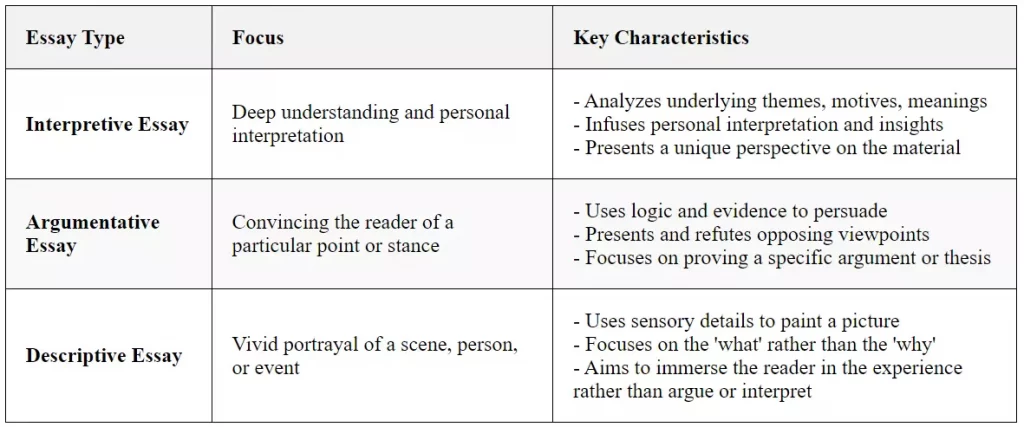
Contrasting with Other Essay Types
Unlike argumentative essays, which focus on convincing the reader of a particular point through logic and supporting details, or descriptive essays, which aim to portray a scene or situation vividly, interpretive essays go into the why and how of a subject. They seek to unpack the layers of significance and offer an individual perspective on the material.
Key Elements of an Interpretive Essay:
- Central Claim: This is the main idea or literary interpretation that drives your essay.
- Textual Proof: Use facts, quotes, and details from the source material to back up your central claim.
- Reading: Add your own insights and perspectives to deepen the interpretation and show what the work means.
Grasping these basics is important for crafting an essay that does not just retell the plot but also brings an engaging perspective to the subject matter.
How Do You Choose a Topic for an Interpretive Essay?
Choosing the right topic is the first step in writing an interpretive essay. Students should pick something that genuinely grabs their attention and offers plenty of material to work with. A strong essay topic for a literary interpretation has three qualities: it is engaging, it has depth, and the writer has access to enough sources to make a real case.
Engaging: Choose something that genuinely interests you. Your enthusiasm will show in your writing, making the essay more compelling for your readers.
Rich in Content: Opt for a topic with depth, one that allows you to explore multiple layers of meaning and literary interpretation.
Accessible: Make sure you have enough resources and understanding to examine the topic effectively.
A strong topic will encourage you to think carefully and share your unique viewpoint.
Examples of Good Interpretive Essay Topics:
- Analyzing Symbolism in ‘To Kill a Mockingbird’: Go through the rich symbols Harper Lee uses and their implications for racial justice.
- Interpreting the Themes of Power and Corruption in ‘Animal Farm’: Explore how Orwell portrays power dynamics and their effects on individuals in the text.
- A Personal Take on ‘The Great Gatsby’ and the American Dream: Offer your literary interpretation of Fitzgerald’s critique of wealth and aspiration.
- Understanding the Role of Women in ‘Pride and Prejudice’: Examine the portrayal of women and societal expectations in Austen’s era through close reading.
- Decoding the Allegory in Plato’s ‘Allegory of the Cave’: Provide a contemporary interpretation of this philosophical work and what it means for how we understand knowledge.
- Examining the Concept of Justice in ‘The Merchant of Venice’: Explore Shakespeare’s portrayal of justice and mercy and how these themes are woven through the figures and the plot.
- Interpreting the Themes of Isolation and Identity in ‘Frankenstein’: Examine how Mary Shelley addresses isolation and the quest for identity through the individuals of Victor Frankenstein and his creation.
Choosing the right topic makes it much easier to write an interpretive essay that holds together from start to finish and leads to a richer, more engaging piece.
How Do You Conduct Literary Analysis for an Interpretive Essay?
Literary interpretation begins with a careful reading of the source. Whether students are exploring literature, visual media, or historical documents, the following strategies will help them write a strong interpretive essay. The goal is to move from what the text says to what it means, and then to why that reading matters.
Close Reading or Observation: For a literary work, this involves reading carefully, paying attention to details, patterns, and subtleties. For visual media or film, it requires closely observing composition and technique. Note anything that repeats or feels significant.
Contextualizing: Understand the historical, cultural, and biographical background of the work. This context can offer deeper insights into its message and help you interpret the choices the author made.
Asking Questions: Ask probing questions about the source. Why did the author use a particular symbol? What is the significance of a recurring motif? How do the figures evolve throughout the story? How does the location or time period shape the theme or reinforce the author’s message? These questions drive the analysis forward and help you build a case rather than just summarize.
Identifying Themes, Symbols, and Motifs
Themes, symbols, and motifs are the building blocks of literary interpretation. Identifying these literary components involves looking for:
- Themes: The central ideas or messages in the work. What is the author trying to convey about life, society, or human nature?
- Symbols: Objects, figures, or events that carry deeper meanings past their literal sense.
- Motifs: Recurring parts that help develop and highlight the themes.
Linking Your Reading to Personal Interpretation
Next, connect your reading to your own interpretation. This involves:
- Reflection: Think about how the themes, symbols, and motifs resonate with your own experiences or views.
- Developing a Perspective: Use your reading to form a distinctive perspective on the work. How does it align with or challenge your own beliefs or understanding?
- Forming a Position: Your literary interpretation should lead to a clear central claim, which you will back through close examination of the text.
Effective literary interpretation in an interpretive essay is about weaving your reading into a coherent and meaningful argument. Each piece of textual proof should connect back to that central claim. components; it’s about weaving these elements into a coherent and personally meaningful narrative.
How Do You Write a Thesis for an Interpretive Essay?
The thesis statement is the backbone of your interpretive essay. It should be clear, concise, and convey the main point or perspective you will be arguing in your essay. A well-crafted interpretive claim is specific, arguable, and insightful. Every body paragraph needs to connect back to it and show how your reading of the text backs that position.
- Specific: It clearly defines the focus of your essay.
- Arguable: It presents a viewpoint or literary interpretation that can be supported with textual proof.
- Insightful: It goes past the apparent meaning, offering a fresh perspective or new understanding of the source material.
The connection between your central claim and the points in each paragraph is what makes an interpretive essay convincing. Every main paragraph should:
- Back the Main Claim: Every point you make should tie back to and reinforce your position.
- Provide Textual Proof: Use quotes, examples, and details from the source material to ground your points in each paragraph.
- Reflect Coherence: Your points should be logically structured and build on one another.
Examples of Effective Interpretive Essay Thesis Statements:
- On ‘The Catcher in the Rye’: “In J.D. Salinger’s ‘The Catcher in the Rye’, the motif of the catcher symbolizes the protagonist’s desire to protect children from the difficulties of adulthood, reflecting his own resistance to growing up.”
- Regarding Climate Change Narratives: “Climate change narratives in contemporary literature reflect a collective unease about an uncertain future and urge a deeper societal change.”
- On ‘1984’ by George Orwell: “Orwell’s ‘1984’ extends past political critique to offer a reading of the human psyche under totalitarian rule and its capacity for resilience.”
These examples show how a strong central claim helps both the writer and the audience by shaping the way they examine and discuss the source material. A clear claim also makes the overall argument easier to follow because every paragraph has a defined job: to add proof that makes the interpretation more convincing.
How Do You Structure an Interpretive Essay?
An interpretive essay follows a clear essay structure: an introduction, body paragraphs, and a conclusion. Students who understand this format can write more efficiently because they know where each idea belongs. Each section supports the central claim in a specific way, and together they create a coherent literary interpretation.
- Introduction
- Purpose: Introduces the topic, provides background information, and presents the central claim.
- Components: Hook to grab attention, context about the source material, and a clear, concise central claim that your literary interpretation will back.
- Body Paragraphs
- Purpose: Develops and grounds the central claim through close reading and literary interpretation.
- Structure: Each section focuses on a specific aspect of the overall reading.
- Components: Topic sentence for each paragraph, textual proof from the source, and interpretation that ties back to the main claim.
- Conclusion
- Purpose: Draws together the main points and restates the central claim in light of the reading conducted.
- Components: Restatement of the main claim, a recap of key points, and a final thought that leaves a lasting impression.
The key to a successful interpretive essay is balance: describe what the source material says, examine the literary components, then offer your own interpretation. Make sure that each body paragraph contributes to and grounds your central claim.
How Do You Write Each Body Paragraph?
A strong body paragraph in an interpretive essay follows a consistent pattern that keeps your argument clear and well-grounded. Each supporting paragraph should open with a topic sentence that names the specific aspect of your interpretation you are addressing. Then bring in a quotation or detail from the text to support that claim. After the quotation, write 2-3 sentences that explain what it shows, why it matters, and how it connects to your central argument. Close each paragraph by linking back to your thesis or setting up good transitions to the next point.
Writers who work with literature often find that the analysis sentences are the hardest part of the writing process. The most common mistake is quoting the text and then moving on without explaining the significance. Every piece of textual proof needs interpretation to carry weight. Ask yourself: what does this quotation prove, and how does it support my central message about the work? Keeping this question in mind throughout the whole essay stops you from drifting into a summary.
When planning how many paragraphs to write, aim for at least three. Each one should address a separate strand of your interpretation, such as a distinct theme, a symbol, or a character’s development. This structure gives your analysis enough depth to be persuasive and gives the literature enough room to speak through close examination.
Interpretive Essay Outline Example: ‘The Symbolism of the River in Huckleberry Finn’
- Introduction
- Hook: An intriguing idea about the symbolism of nature in literary works.
- Background: Brief overview of ‘The Adventures of Huckleberry Finn’ by Mark Twain.
- Central Claim: “In ‘The Adventures of Huckleberry Finn,’ the Mississippi River symbolizes freedom and change, reflecting the transformative journey of Huck and Jim.”
- Body Paragraphs
- Paragraph 1: Exploration of the river as a symbol of freedom.
- Textual proof from the source.
- Literary interpretation of how the river reflects the characters’ quest for freedom.
- Paragraph 2: Reading of the river as a metaphor for change and transformation.
- Specific examples from key scenes in the text.
- Interpretation of the river’s role in the characters’ development.
- Paragraph 3: Discussion of Twain’s use of the river to challenge societal norms of the time.
- Historical context and textual proof.
- Interpretation of the river’s symbolism in relation to Twain’s critique of society.
- Paragraph 1: Exploration of the river as a symbol of freedom.
- Conclusion
- Restatement: Emphasizing the multifaceted symbolism of the river.
- Recap: Brief overview of main points and interpretations.
- Closing Thought: Reflecting on the enduring relevance of the river’s symbolism in the novel.
This framework helps students write a detailed literary interpretation, making sure the essay is clear, well-grounded, and encourages thoughtful reflection.
Key Takeaways for Writing an Interpretive Essay
When students interpret literature, they explain the meaning they perceive to someone else. This goes past stating facts. It requires making an inference and backing that inference with textual support.
Starting Point: Begin by identifying the title, author, and necessary background details so the reader understands the context of your literary interpretation. This grounds your main claim before you write the first paragraph.
Central Claim: An interpretive essay argues that an idea about the text is not apparent on the surface and can be supported with specific evidence. You need to move beyond the surface facts and explain what they imply. Strong interpretive claims might explore:
- Motive: Why do the figures act the way they do?
- Changes: How do the individuals evolve throughout the story?
- Theme: What message about life is the text conveying?
- Symbols: What recurring parts represent major themes like life and death?
- Judgment: Is the novel credible or limited in its perspective?
- Textual Proof: Good proof does not speak for itself. You need to guide your reader through the text, showing exactly how each quotation or detail backs your central claim. For example, if you want to prove that a symbol represents loss, find a specific passage that shows that connection, quote it, and then explain the link. Every time you make an interpretive claim, support it with a line from the text.
Conclusion: Tie your ideas together by recapping what you have shown across all paragraphs. Explain how your literary interpretation should change the reader’s perspective on the work. Students who take time to write a strong conclusion leave the reader with a clear sense of why the reading matters. You can also refer back to the hook or opening context to give the paper a satisfying close.
Think about the elements of the text you analyzed and how they connect to the world the author created. A strong conclusion does not just restate. It shows the contrast between a surface reading and the deeper interpretation your essay has built.
Common Questions Students Ask About Interpretive Essays
What is the difference between an interpretive essay and a summary? A summary retells what happens in a text. An interpretive essay explains what the text means and supports that reading with specific proof from the source. Students often write summaries when they should be writing literary interpretation. We see this pattern frequently: a draft will describe what happens in detail but never state what those events reveal about the work’s central theme or message.
How long should an interpretive essay be? Most interpretive essays for literature courses run between 500 and 1500 words, depending on the assignment. Each body paragraph should be long enough to present a point, provide textual support, and explain what that support means for your central claim.
Can you use the first person in an interpretive essay? Some instructors allow the first person in interpretive writing. When in doubt, check with your instructor. Many students find that writing “this passage suggests” or “the text indicates” keeps the focus on the work rather than on the writer, which strengthens the literary interpretation.
Was this article helpful?

Written by
Terry is a Chicago-based writer and editor who creates practical, student-friendly guides on essay writing, research, and citation styles (APA, MLA, and Chicago). He’s spent 15+ years editing educational content and building clear examples that help readers apply rules without guessing. When he’s not revising drafts, he’s usually turning messy notes into clean outlines and hunting down the one detail everyone skips.