The most effective ways to shorten an essay are to eliminate redundancies, combine sentences with similar ideas, drop backward references, and read your draft aloud to catch what feels heavy. Knowing how to shorten an essay without losing its argument or quality is one of the most practical editing skills a student can develop.
High school and college essays often have strict word count limits. According to the University of Wisconsin Writing Center, managing word count is one of the most common editing challenges students face. It can be challenging to express your opinion, analyze a historical event in full, or tell a good story within, let’s say, 500 words. When you exceed your word limit, you end up cutting content to reduce your essay’s word count.
To reduce word count, you can:
- Eliminate redundancy (unnecessary words)
- Combine sentences with similar meanings
- Avoid referring back
- Listen to your writing
Note: You can reverse some tips from our article about essay lengthening.
1. Edit out redundancies and reduce wordiness
Redundancy in linguistics refers to using words or phrases that repeat the same point or can be inferred from context. In academic writing, redundancy is unwelcome. When you hit your required word count limit, start here: eliminating unnecessary words usually yields the biggest savings across the entire paper.
Eliminating redundancy
To determine what can be removed from a sentence, check if the original meaning remains unchanged after the edits.
Original: I was absolutely certain that each and every quote I provided in my essay about politics made my argument much more compelling.
Let’s edit and shorten the sentence above.
Edited: I was sure every fact in my essay made my argument compelling.
We removed 10 words while keeping the meaning the same. This applies to any essay, research paper, or personal statement: “absolutely certain” is redundant (you’re certain or not), “each and every” repeats the same point, “I provided” is implied, and “about politics” adds no context.
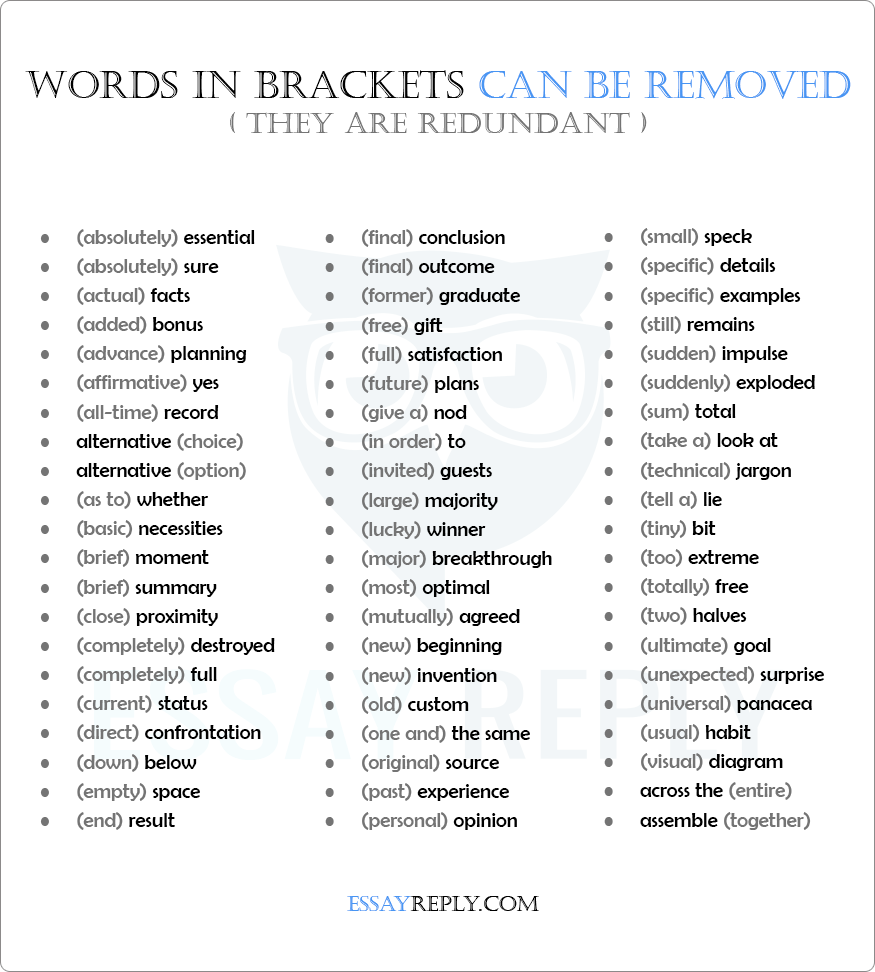
Below is a list of phrases that contain redundancies, removing which you can make your college essay shorter without losing anything.
Eliminating wordiness
Wordiness means using phrases that can be replaced with one or two words, or choosing a sentence structure loaded with articles and prepositions. Every unnecessary word pushes your essay’s word count further past the word limit. According to Purdue OWL, eliminating wordiness is one of the most reliable paths to concise academic writing.
To eliminate wordiness, you can:
- Avoid using passive voice
- Replace heavy phrases
- Favor noun clusters
- Use verbs for action
- Stop the preposition train
- Use fewer fillers and qualifiers
Here are quick before-and-afters for each method.
Using the active voice
Switch passive voice to active voice to cut words and remove awkward phrasing. Active voice names the doer directly, which makes the sentence shorter and clearer.
Original (passive voice): The process of essay shortening is often found to be a challenging task.
Edited (active voice): Students often find essay shortening challenging.
Simplifying long phrases
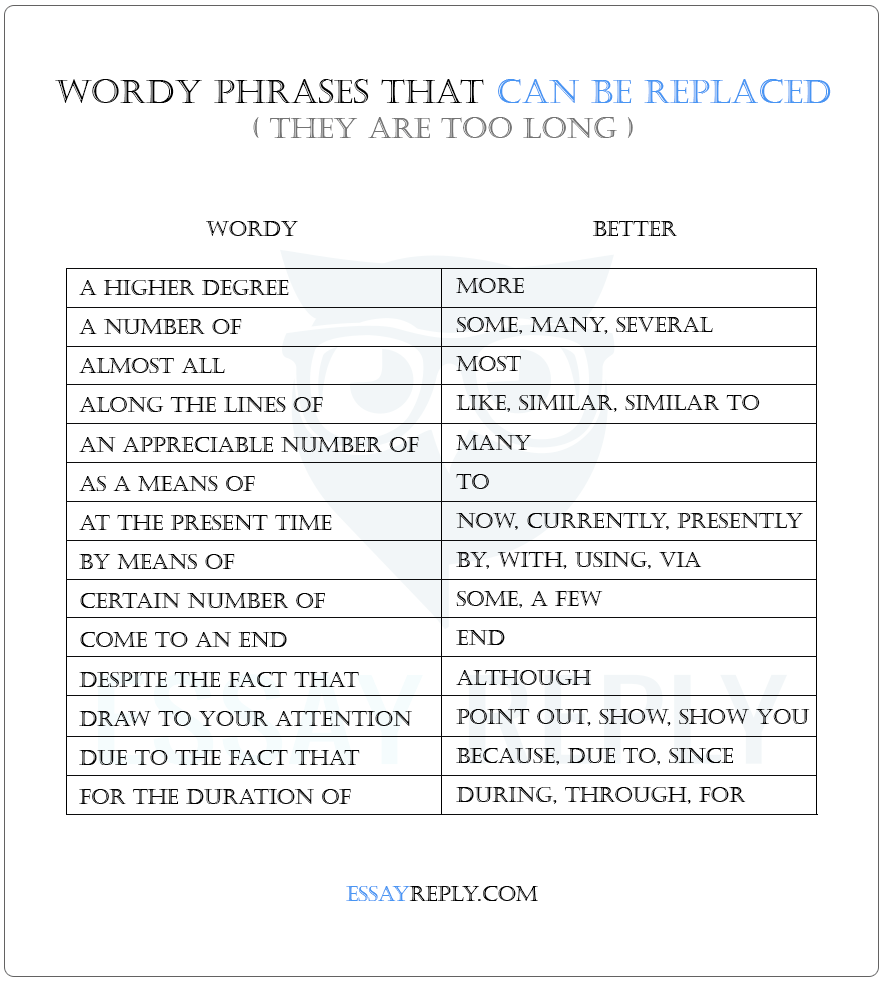
Replace wordy phrases with shorter equivalents. The image below lists common phrase swaps used in academic writing.
Original: Due to the fact that the majority of papers have to fall in line with length limitations, students are required to gain an understanding of how to put their thoughts into words clearly.
Edited: Because most papers must meet length requirements, students should learn how to express their thoughts clearly.
Expressing action through verbs
Prefer the verb form over a noun derived from a verb (called “nominalization”). Nominalized sentences are wordy and weak. Converting them to verbs often removes 3-5 extra words per sentence.
Original: The economic destabilization is the consequence of the government’s failure to implement effective economic policies.
Edited: The government’s failure to implement effective economic policies destabilized the economy.
Cutting prepositions, fillers, and qualifiers
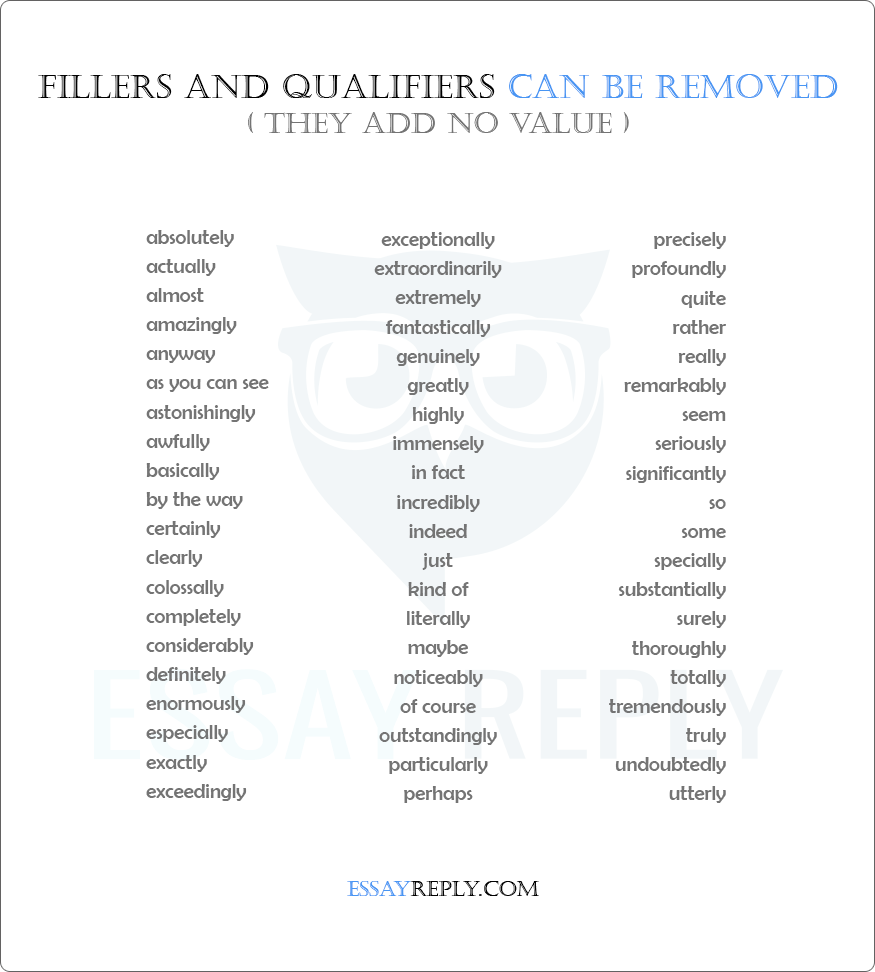
Filler words (“really,” “basically,” “in order to”) and qualifiers (“quite,” “rather,” “very”) add words without adding meaning. Reducing extra words and prepositional phrases lowers your word count without sacrificing substance.
Original: It’s quite important to note that the study revealed rather interesting results.
Edited: The study revealed intriguing results.
By applying these tips, you can build stronger editing habits. Sentence-level work (cutting filler words, removing redundancy, replacing passive voice with strong verbs) is where the biggest word-count savings appear. An essay shortener tool can speed up this process, but manual review ensures you keep the main point of each paragraph intact.
You can use these Purdue University wordiness exercises to check yourself.
2. Combine sentences with similar meanings
To combine sentences effectively, identify two or more consecutive sentences that share the same core idea and merge them into one. This single edit can cut 10 to 20 words per paragraph without sacrificing meaning, making it one of the fastest techniques for shortening an essay during revision.
When speaking, we use new sentences to elaborate on previous ideas and add a new meaning. Typically, we speak in longer sentences than we do in writing. If you write the same way you talk, it will take a toll on your essay’s word count.
Original: Many students find it difficult to write within the essay length limit imposed by schools. I also often struggle to fit my essays into the word count confines.
That sentence contains a lot of information that we can combine into a shorter passage.
Edited: Like many students, I find it hard to write essays within the length requirements.
The revised sentence is half the word count with no loss in meaning. Applying this consistently across a college essay can save 100-150 words overall. When two sentences share one idea, merge them. When a sentence is too long to parse, split it.
Paragraph-level revision example
Sentence combining works at the paragraph scale, too. Here’s how to shorten a passage from 74 words to 34 by merging sentences:
Original (74 words): The issue of climate change is one that has been discussed by many people in recent years. Scientists have been studying the matter and have come to various conclusions. Many of them believe that human activity is the main cause. They point to rising temperatures, melting glaciers, and more extreme weather as evidence that governments around the world must act soon.
Edited (34 words): Scientists broadly agree that human activity drives climate change, citing rising temperatures, melting glaciers, and increasingly severe weather as evidence that urgent government action is needed.
The revised version reduces the word count by 54% without losing any of the core claim or supporting evidence.
Compress your examples
Examples are often the wordiest parts of an essay. Trimming entire paragraphs of example detail cuts more words than sentence-level work. “Zoom out” on any example that runs more than three sentences and cut it to the essential point. If you cannot cut it, replace it with a shorter one or remove it entirely.
3. Don’t refer to previous paragraphs
Avoid linking to previous information in an essay. It wastes words and disorients the reader. Phrases like “as it was mentioned before” or “from the last paragraph, we can conclude” are redundant. Each paragraph should make its main point clearly without sending readers back to re-read earlier sections.
Original: As it was mentioned earlier, we can improve our education system by…
Edited: We can improve our education system by…
Many students make this mistake when writing a conclusion. They give a mere summary of the body paragraphs when, instead, you must tie them together and provide a broader context without sending the reader back.
4. Listen to your essay
Reading your essay aloud, or using a text-to-speech tool, lets you hear sentences that drag, sound repetitive, or drift off-topic. What looks fine in print often sounds bloated when spoken, which makes the listening method one of the most reliable final checks before you submit.
Luckily, you don’t need to wait for thunder and get your essay struck by lightning to do that. Use Google Translate’s “listen” button or ask somebody to read it out loud for you. Once you hear your writing, you might identify the parts worth deleting. When listening to your essay being read out loud, pay attention to:
- Sentences that feel too long and heavy
- Awkward phrasing or sentences that sound clunky
- Areas that stray off the topic
Each time you spot something from the list above, pause and reread that part to see if it can be fixed.
This suggestion encourages you to see things from the reader’s perspective, helping you eliminate any lengthy or awkward phrases.
The best way to shorten an essay is by combining all our tips. After several revisions, you will shrink your text without losing its meaning or quality.
Some online tools can also help you cut words and shorten a paragraph or an entire paper:
- Essay shortener tools: A good essay shortener can suggest cuts across an entire draft. It highlights over-long sentences and flags where the essay shortener works best (typically redundant clauses and repeated ideas). Always review its suggestions before accepting.
- Paragraph shortener: A paragraph shortener flags the longest paragraphs by word count, giving you a clear target. Use it to shorten paragraph by paragraph rather than guessing where to cut.
- Grammarly: its free version is enough to weed out all the fillers and qualifiers.
- OneLook reverse dictionary: helps you replace a wordy concept with fewer words and avoid repetition.
- ClicheFinder: get rid of cliche phrases or substitute them with shorter equivalents. “You can’t draw blood from a stone” can easily become “impossible” or “futile.”
How to Shorten an Essay: A Quick Editing Checklist
Work through this checklist in order to get the most word savings from each pass. Later steps produce smaller gains, so stop once you hit your target length.
- Cut full sentences or entire examples that don’t directly support your thesis. This is the highest-yield step and the fastest way to cut words in bulk.
- Eliminate redundant and wordy phrases using the lists in Section 1 above. Pay special attention to filler words (“basically,” “actually,” “in order to”) that add length without adding meaning.
- Combine related sentences that repeat the same idea in slightly different words.
- Remove backward references such as “as stated earlier” or “from the previous paragraph.”
- Read the draft aloud and pause at anything that sounds heavy or off-topic.
This skill builds with practice. Over time, you spot the same problem patterns in your own writing style, and you need fewer words to express the same ideas. The goal is to write more clearly, not just shorter.
Mini-FAQ
Academic assignments have word limits to make sure students learn to write clearly and concisely. Another reason is to ensure equality so that everyone does the same amount of research. And, a word count limit acts as a guide, forcing you to be more to the point and plan your writing.
There are a few things that can help you stick to the word limit from the very beginning. First, create a clear thesis statement that allows you to narrow your focus and stay on the subject. Second, prepare a detailed outline that will define the ideas you want to include. Third, monitor the word count every ten or twenty minutes to see how much space you have left.
Besides the things we cover in our article, you can try replacing phrasal verbs with one-word versions (e.g., “get back” to “return”). You can also run your draft through an essay shortener tool to flag the longest sentences, then decide which ones to trim manually. Phrases separated with a comma (like “to be honest” or “in fact”) can also be safely removed.
It depends, but a 10% margin should be fine. If another 100 words will make a difference, consider keeping them. However, you should always try to stay under the limit indicated in the requirements, especially if it is a college application essay you’re working on.
The list of references
- Writing Concisely, University of North Carolina at Chapel Hill
- Effective Use of Language, University of Washington
- Get Better at Essay Writing: practical tips to strengthen your overall writing process
Was this article helpful?

Written by
Terry is a Chicago-based writer and editor who creates practical, student-friendly guides on essay writing, research, and citation styles (APA, MLA, and Chicago). He’s spent 15+ years editing educational content and building clear examples that help readers apply rules without guessing. When he’s not revising drafts, he’s usually turning messy notes into clean outlines and hunting down the one detail everyone skips.