Writing about George Orwell’s Nineteen Eighty-Four means confronting a text that has burrowed deep into the cultural psyche. This guide will help you dissect its themes, structure your arguments, and produce a compelling essay. We will move from foundational concepts to advanced analysis, giving you the tools to write with clarity and confidence about this chilling piece of dystopian fiction.
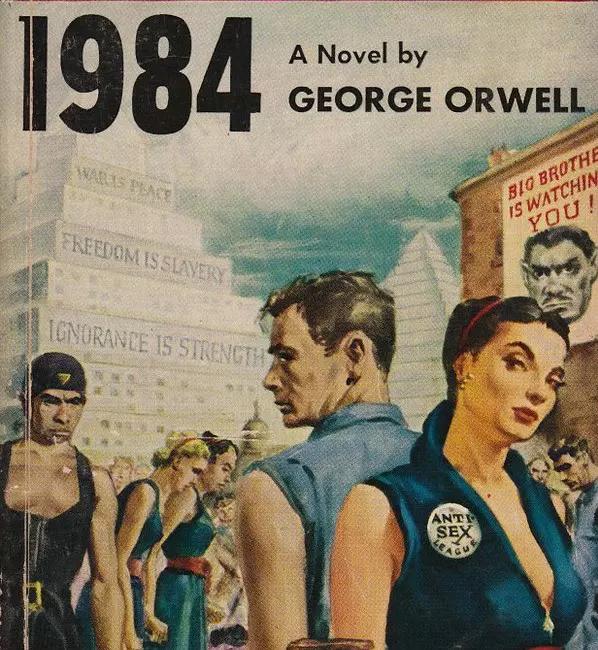
TLDR: Your Quick Guide to a Great 1984 Essay
- Main Message: George Orwell warns against totalitarianism, showing how a government can use psychological manipulation, surveillance, and the distortion of truth to maintain absolute control.
- Core Themes: Focus your essay on power, control, technology as an oppressive tool, the nature of reality, and the struggle for individuality.
- Top Topics: Analyze the function of Newspeak, the role of technology, the psychology of doublethink, or compare the book’s warnings to the world today.
- Structure is Key: Start with a sharp thesis statement, build your case with evidence-backed body paragraphs, and stick to a clear essay structure.
- Go Deeper: Don’t just summarize. Question the text. Explore Orwell’s depiction of human psychology and the mechanisms of a totalitarian society.
Understanding the Core of Nineteen Eighty-Four
George Orwell did not write a simple story. He crafted a warning. Published in 1949, in the shadow of World War II, the dystopian novel channels the anxieties of an era that witnessed the rise of brutal totalitarian regimes. The main argument of Nineteen Eighty-Four is that absolute power, when sought for its own sake, will inevitably seek to extinguish human freedom in its entirety, not just in action but in thought itself. The central message is a defense of objective truth and individual consciousness against the crushing weight of state-sponsored lies and total control.
The world of Oceania is not just oppressive; it is an inversion of reality. The Party, led by the ever-present figurehead of Big Brother, dominates every aspect of everyday life. This isn’t just about forbidding certain actions. It’s about making them unthinkable. Imagine living in a place where your own mind is the final frontier of a brutal war. This is the reality for the protagonist, Winston Smith. Orwell uses Winston’s perspective to show how a totalitarian state maintains its grip not just through force, but through a constant, grinding psychological manipulation that seeks to sever a person’s connection to their own memories and perceptions.
A quick tip: When you write your essay, think of the Party not as a standard government, but as an entity that wants to become God. It desires to redefine reality itself.
Deconstructing the Major Themes for Your Essay
A strong 1984 essay must be built on a solid understanding of the novel’s themes. These are the big ideas that George Orwell explores. You can build your entire essay around one of these, or show how several of them connect.
Power and Absolute Control
O’Brien, a high-ranking member of the Inner Party, tells Winston that the Party seeks power for its own sake. Not for good, not for wealth, but purely for power. The sensation of control is the end goal. He describes a future that is a boot stamping on a human face, forever. This is perhaps the most terrifying and important concept in George Orwell’s book. The Party’s control is total. It dictates history, science, and even the laws of nature. When your essay touches on power, it’s not just political power. It’s metaphysical control. The Party doesn’t just want to stop you from saying “two plus two equals four”; it wants the power to make you believe that two plus two equals five.
Psychological Manipulation and Reality Control
How does the Party achieve such awesome control? Through a relentless assault on the human mind. This is a rich area for any essay. Consider these three pillars of manipulation:
- Newspeak: The official language of Oceania, engineered to narrow the range of thought. It’s not just about replacing words; it’s about eliminating concepts. How can you rebel if you don’t have the words for rebellion, freedom, or individuality? Orwell, a master of prose, understood that language shapes reality. By destroying language, the Party destroys the ability to form heretical thoughts.
- Doublethink: This is the linchpin of Oceania’s psychology. Orwell writes that it is the power to “hold simultaneously two opinions which cancelled out, knowing them to be contradictory and believing in both of them.” It’s being “conscious of complete truthfulness while telling carefully constructed lies.” This is more than hypocrisy; it’s a form of cultivated insanity, a necessary skill for survival and advancement within the Party. It represents a society suffering from a profound, state-induced cognitive dissonance. The constant adjustment of the past requires everyone, especially Party members, to accept new facts and forget the old ones instantly.
- Falsification of History: Winston Smith’s job at the Ministry of Truth is to rewrite historical records to match the Party’s current narrative. If the Party says it has always been at war with Eastasia, the records must reflect that, even if everyone remembers being at war with Eurasia just last week. This continuous alteration of the past destroys any objective standard of truth, leaving only the Party’s version of events. It’s a world built on institutionalized fake news.
Surveillance and the Death of Privacy
The iconic phrase “Big Brother is watching you” encapsulates this theme. In Nineteen Eighty-Four, surveillance is omnipresent. Telescreens watch and listen to citizens in their homes, while the Thought Police hunt for signs of dissent, a crime they call “thoughtcrime.” There are no private spaces. A flicker of the eye, a muttered word in sleep, a diary entry, all can lead to arrest and vaporization. This constant monitoring induces a state of perpetual self-consciousness, forcing individuals to police their own thoughts. It’s a powerful mechanism of social control. Your essay could connect this fictional government surveillance to modern concerns about the digital age, social media, and data collection, making George Orwell’s dystopian vision feel alarmingly current.
Individuality vs. The Collective
Winston Smith is a fragile hero. His rebellion is deeply personal. It begins with the illegal act of buying a diary. It grows with his love affair with Julia. These are attempts to carve out a small space for personal feeling and experience in a world that demands total conformity. He is fighting for the right to have a past, to love, to feel, and to believe in an external reality. Orwell’s depiction of Winston’s struggle highlights a central conflict in much dystopian literature: the value of the individual spirit against an overwhelming, dehumanizing force. Does his ultimate failure mean that the struggle is pointless? That is a question your essay can explore.
Choosing Your 1984 Essay Topic
So, what should you write your 1984 essay on? The possibilities are vast. Instead of a generic theme summary, try to formulate a specific, arguable question. A good topic leads to a strong, focused essay. Here are some ideas, ranging from foundational to advanced, to get you started. For more inspiration, you can always check out lists of essay topics and ideas.
- Topic 1 (Technology): Is technology the true villain of Nineteen Eighty-Four? Or is it a neutral tool that is simply used for nefarious purposes by the Party?
- Topic 2 (Psychology): Analyze Orwell’s use of doublethink as a tool of psychological control. How does it function to maintain the Party’s power and what does it reveal about human psychology?
- Topic 3 (Character Analysis): Is Winston Smith a hero? Analyze his motivations, actions, and ultimate fate to argue for or against his status as a heroic figure in the context of the oppressive regime.
- Topic 4 (Symbolism): Discuss the significance of key symbols in the novel, such as the glass paperweight, the Golden Country, or the prole woman singing. What do these symbols represent in Winston’s fight for individuality?
- Topic 5 (Relevance): In what ways does Nineteen Eighty-Four serve as a relevant warning for the 21st century? Discuss specific parallels between the novel’s world and contemporary issues like media manipulation or surveillance.
- Topic 6 (Comparative): Compare and contrast the methods of social control in George Orwell’s Nineteen Eighty-Four with those in another dystopian novel, like Aldous Huxley’s Brave New World or Orwell’s own Animal Farm. What do the differences between these two novels reveal about their authors’ primary concerns?
Crafting a Killer 1984 Essay: A Step-by-Step Guide
Once you have a topic, you need a plan. A well-structured essay is a convincing essay. It shows that you have organized your thoughts logically. Think of it as building a case, with each paragraph laying another brick in your argument. You can learn more about the fundamentals by asking what is an essay and how it’s structured.
The All-Important Thesis Statement
Your thesis statement is the single most important sentence in your essay. It is your main argument, boiled down to one or two clear sentences, usually placed at the end of your introduction. It must be specific and arguable. A weak thesis is a simple statement of fact. A strong thesis presents a claim that needs to be proven.
Weak Thesis: “George Orwell’s Nineteen Eighty-Four is about a totalitarian society that uses technology to control its citizens.” (This is a summary, not an argument.)
Strong Thesis: “While the telescreen represents the brute force of physical surveillance, it is Orwell’s invention of Newspeak that serves as the Party’s ultimate weapon, proving that the control of language is more devastating to human freedom than the control of bodies.” (This is a specific, arguable claim that sets up the entire essay.)
Structuring Your Essay
The classic essay structure is your best friend. It’s logical and easy for your reader to follow. It ensures your argument unfolds in a clear, persuasive way.
“In Nineteen Eighty-Four, George Orwell presents the erosion of memory not as a passive consequence of oppression, but as an active, strategic tool of psychological warfare essential to the Party’s absolute control. [Topic sentence] Winston Smith’s job in the Ministry of Truth, for example, involves the daily “rectification” of historical documents, where he methodically erases people and alters events to align with the Party’s ever-changing narrative. [Supporting evidence] This constant rewriting of the past systematically dismantles objective truth, leaving citizens adrift in a sea of uncertainty where their own memories are unreliable and the only anchor is the state’s pronouncements. [Evidence analysis] Ultimately, this manufactured amnesia is the foundation upon which the more overt forms of control, like physical torture, are built. [Transition sentence]“
Building Strong Body Paragraphs
Each body paragraph should explore a single idea that supports your thesis statement. Think of the acronym PEA: Point, Evidence, Analysis.
- Point: Start with a clear topic sentence that states the main point of the paragraph.
- Evidence: Provide a quote or a specific example from the text. Don’t just drop quotes in. Introduce them and integrate them smoothly into your sentences.
- Analysis: This is the most important part. Explain how your evidence proves your point. Do not just summarize what the quote says. Analyze it. What does it mean? Why is it significant? How does it support your overall thesis? This is where you show your critical thinking.
Full Essay Example: The Architecture of Belief
Here is a full-length sample essay to illustrate how these components come together. This essay explores the idea that the Party’s most profound form of control is not physical, but mental.
In George Orwell’s Nineteen Eighty-Four, the chilling image of a boot stamping on a human face forever has come to symbolize the brutality of the Party’s rule. This focus on physical dominance, however, can obscure the novel’s more terrifying argument: that the ultimate expression of totalitarian power lies not in the breaking of bodies, but in the systematic demolition and reconstruction of the human mind. The Party’s true project is not merely to enforce obedience but to conquer internal reality itself. Through the tripartite assault of weaponized language, manufactured memory, and mandated delusion, George Orwell argues that the most effective form of control is one that makes independent thought impossible, thereby erasing the individual long before they are vaporized.
The first stage of this mental conquest is the dismantling of language. In Oceania, Newspeak is not simply a tool of censorship but an instrument of cognitive limitation. As the linguist Syme explains to Winston Smith, the goal is to narrow the range of thought, making “thoughtcrime” literally impossible because the words to express it no longer exist. Orwell presents this as a surgical procedure on the collective consciousness. By eliminating words like “freedom” and “individualism,” and reducing complex negative concepts to prefixes like “ungood,” the Party removes the very building blocks of rebellious or critical ideas. This linguistic impoverishment ensures that even if a feeling of dissent arises, it remains a vague, formless discontent, unable to be articulated, shared, or developed into a coherent philosophy. The destruction of language is the destruction of the architecture for belief, leaving the mind with only the pre-approved blueprints supplied by the Party.
With language shackled, the Party next turns its attention to memory, the anchor of individual identity. Winston Smith’s work at the Ministry of Truth is the engine of this process, where the past is not just rewritten but continuously recreated. The Party’s slogan, “Who controls the past controls the future: who controls the present controls the past,” is the operating principle of the entire totalitarian society. By constantly altering records, from newspaper articles to photographs, the Party severs the connection between personal memory and external verification. This creates a profound state of uncertainty, a psychic vertigo where one’s own recollections are rendered untrustworthy. If the Party can declare, with all evidence supporting it, that Oceania has always been at war with Eastasia, then an individual’s memory of a war with Eurasia becomes a symptom of a faulty mind. This is a devastating form of psychological manipulation, forcing the citizen to abandon their own experiences in favor of the state’s infallible, yet perpetually changing, truth.
The final and most sophisticated tool in this assault on the human brain is doublethink. This is the mechanism that allows the citizen to actively participate in their own mental subjugation. Doublethink is the act of holding two contradictory beliefs simultaneously and accepting both. It is the faculty of knowing that you are telling carefully constructed lies while genuinely believing them. This is not mere hypocrisy; it is a learned and necessary state of mind for survival under Big Brother. When O’Brien tortures Winston, his goal is not a false confession but a genuine conversion. He aims to make Winston believe that two plus two equals five. This demonstrates the Party’s ultimate ambition: to make external reality irrelevant. Reality, O’Brien insists, exists only in the mind of the Party. Doublethink is the bridge that allows an individual to abandon their own perceptions and adopt the Party’s, making them a willing accomplice in the erasure of their own sanity.
In conclusion, while the threat of physical violence is ever-present in Orwell’s nightmare world, it serves primarily as a crude enforcer for a much deeper and more insidious project. The true terror of Nineteen Eighty-Four is the revelation that a totalitarian regime’s final frontier of control is the human soul. By systematically dismantling language, memory, and logic, the Party achieves a form of power far more absolute than any whip or gun could provide. It engineers a dystopian society where the citizens themselves become the guardians of their own prisons, their minds rewired to not only accept but to love their servitude. Orwell’s enduring warning is that the boot stamping on the face is merely the consequence; the true catastrophe is the mind that has been conditioned to welcome it.
Using Scholarly Sources
Integrating academic criticism can elevate your essay from good to great. It shows you have engaged with the broader conversation about the novel. Here are three excellent sources you can use:
- The Dynamics of Terror in Orwell’s 1984: This source is perfect for an essay focusing on fear. It explores how the Party uses unpredictable terror, not just brute force, to keep its citizens compliant. It helps explain the atmosphere of dread that permeates the entire novel.
- Nineteen Eighty-Four and the Ideology of Hate by Kristoffer Rissanen: Use this for an essay on the Two Minutes Hate or the figure of Emmanuel Goldstein. Rissanen argues that the Party manufactures hatred to channel the frustrations of its citizens away from the regime and towards a common enemy.
- From 1984 to One-Dimensional Man: This is a more advanced text that connects George Orwell’s ideas to the philosopher Herbert Marcuse. It’s excellent for an essay that discusses how a society can become so thoroughly controlled that people lose the capacity to even imagine a different way of life.
Advanced Analysis
To really stand out, your essay needs to offer a fresh perspective. Move beyond the standard themes and dig into the more complex mechanics of Orwell’s nightmare world.
The Psychology of Totalitarianism
Orwell was not a psychologist, but his insights into the human brain under duress are profound. Orwell’s depiction of life in Oceania is a case study in trauma. The constant fear, the gaslighting, the demand to deny one’s own senses, it all creates a state of learned helplessness. Citizens become so accustomed to the oppressive regime that they lose the will to resist. You could argue that doublethink is a form of trauma response, a survival mechanism where the human brain splits its own consciousness to endure the unendurable. It is a state where a person must accept the abuser’s reality to survive, even if it means destroying their own. This is a chillingly accurate portrait of the psychology of abuse, scaled up to the level of an entire society.
Language as a Weapon
Many students mention Newspeak, but few analyze it deeply. Orwell provides an entire appendix explaining its principles. It’s not just about fewer words. It’s about creating a language where dissent is impossible because the vocabulary for it has been surgically removed. The destruction of nuance, the elimination of antonyms (why have “bad” when you can have “ungood”?), and the creation of compound words like “thoughtcrime” all serve to mechanize language and, by extension, thought. An advanced essay could analyze the appendix on Newspeak as a key to understanding Orwell’s entire philosophy. It argues that our freedom is inextricably linked to the richness and precision of our language. This is a point many professional writers still make today.
Satire, Parody, and Warning
Is Nineteen Eighty-Four just a grim prediction? Or is it also a satire? Satire uses exaggeration and ridicule to criticize folly and vice. Orwell is satirizing the excesses of the totalitarian regimes he saw in his lifetime, like Nazi Germany and Stalinist Russia. The absurdly named Ministries (Ministry of Truth for lies, Ministry of Love for torture) and the nonsensical Party Slogan (“War is Peace”) are prime examples of this dark, bitter humor. Your essay could explore how Orwell uses these satirical elements not to make us laugh, but to highlight the terrifying absurdity of totalitarian logic. For more on this, exploring the genre of the satire essay can provide a useful framework for your analysis of this work of political fiction and social science fiction.
Character and Society Deep Dive
Understanding the key players and social structure is essential. The world of Nineteen Eighty-Four is rigidly stratified, and each character’s position influences their perspective and fate.
| Character / Group | Role in the Narrative | Key Motivations | Defining Quote |
|---|---|---|---|
| Winston Smith | The protagonist, an everyman from the Outer Party. His perspective allows the reader to experience the horrors of the regime. | A desperate search for truth, memory, and human connection. A desire to feel alive and individual. | “Freedom is the freedom to say that two plus two make four. If that is granted, all else follows.” |
| Julia | Winston’s lover. A pragmatic rebel who enjoys breaking the rules for personal pleasure, not for political change. | Sensual pleasure and personal freedom. She lives in the moment and has no interest in overthrowing the Party. | “I’m not interested in the next generation, dear. I’m interested in us.” |
| O’Brien | A powerful, enigmatic member of the Inner Party who Winston believes is a fellow conspirator but is actually a loyal agent. | The exercise of pure power. He embodies the Party’s sadistic and nihilistic ideology. | “If you want a picture of the future, imagine a boot stamping on a human face—for ever.” |
| Big Brother | The mustachioed face of the Party. He is the object of worship and fear, a symbol of total control. | To serve as a focal point for the emotions of the populace, a substitute for religion and family. | “BIG BROTHER IS WATCHING YOU.” |
| The Proles | The working class, making up 85% of the population. The Party largely ignores them as they are not considered a threat. | Basic survival and simple pleasures. They are concerned with beer, football, and the lottery. | “If there is hope… it lies in the proles.” |
Notice the difference between the Inner Party (the ruling elite, like O’Brien), the Outer Party (the educated workers, like Winston), and the Proles. This social structure is key to how the Party maintains control.
Frequently Asked Questions (FAQ)
What should I write my 1984 essay on?
You should write your 1984 essay on a specific, arguable topic rather than a broad theme. Choose an angle that genuinely interests you. For example, instead of “the theme of technology,” argue a point like, “In Nineteen Eighty-Four, Orwell demonstrates that psychological technology like Newspeak is a more effective tool of oppression than physical technology like the telescreen.” Other strong topics include analyzing a key character’s motivations (Winston Smith, O’Brien), the function of a specific symbol (the paperweight), or the novel’s relevance to the world today.
What is the main message of 1984?
The main message of George Orwell’s classic piece of literature is a stark warning about the dangers of totalitarian governments. It argues that a regime that seeks absolute power will stop at nothing to achieve it, even if it means controlling reality itself. The novel champions the importance of objective truth, individual freedom, and the preservation of human memory and emotion against forces that seek to erase them. It’s a defense of our fundamental civil liberties and the very essence of human nature.
What is the main argument of 1984?
The main argument is that the most dangerous form of totalitarianism is one that seeks not just to control people’s actions, but their thoughts. Orwell argues that by controlling language, history, and information, a totalitarian regime can dismantle a person’s ability to think critically and even perceive reality accurately. The ultimate goal of such a system, as articulated by O’Brien, is not the welfare of the people but power for its own sake, a concept that leads to a nihilistic and endlessly oppressive society.
What is the theme of the 1984 essay?
There isn’t one single theme, but a constellation of interconnected ones. The most prominent themes for a 1984 essay are: the nature of power and control; the dangers of psychological manipulation and the distortion of truth; the impact of surveillance on privacy and freedom; the struggle for individuality against a monolithic state; and the fragility of memory and history. A good essay will focus on one of these as its central theme or show how Orwell weaves several of them together to create his terrifying dystopian vision. The novel’s exploration of these ideas is what makes it such an enduring work of dystopian literature.
Is Nineteen Eighty-Four a prediction of the future?
George Orwell himself said it was not a prophecy, but a warning. He was writing about trends he saw in his own time, particularly in Stalinist Russia and Nazi Germany, and extrapolating them into a possible future. He wanted to show what could happen if these ideologies were taken to their logical extremes. So, while it’s not a one-to-one prediction, its themes of surveillance, media manipulation, and the distortion of language have become increasingly relevant, making it feel prescient in many ways in today’s world. It is a work of political fiction meant to provoke thought about the present, not just the future.
What is the significance of the character Emmanuel Goldstein?
Emmanuel Goldstein is the supposed “Enemy of the People,” a former Party leader who now heads a resistance movement called The Brotherhood. He is the focus of the Two Minutes Hate. However, it’s heavily implied that he and The Brotherhood might be complete fabrications by the Party. His significance lies in his function: he is the necessary enemy. By creating a target for fear and hatred, the Party can unify the population and deflect any anger that might otherwise be directed at the regime. He is a tool of control, a perpetual scapegoat that justifies the Party’s oppressive measures. His very existence, real or not, is a testament to the Party’s mastery of psychological manipulation.
Tackling an essay on Nineteen Eighty-Four is a challenge, but it is a rewarding one. This is not just a book; it is a cultural artifact, a political treatise, and a profound exploration of what it means to be human. By engaging with its deeper themes and complex arguments, you are participating in a conversation that George Orwell started over seventy years ago. A conversation that, perhaps now more than ever, we need to continue. Go beyond summary, question everything, and build an argument that is as thoughtful and deliberate as Orwell’s own prose. You have the tools. Now, get to writing.