Education changes rapidly; teachers modify curricula to adjust them to today’s trends and help learners pick up critical skills. One of such skills is the ability to witness and assess one’s learning. To master such dexterity, course instructors might assign writing reflective papers.
Although it’s not the most common writing task, knowing how to evaluate various occurrences and document them properly will help you excel in academia and understand your strengths and weaknesses. This guide encompasses all the information you need about a reflection paper, from the definition to dos and don’ts.
What is Reflective Writing?
Reflective writing involves selecting a memory, event, interaction, or scene to describe, along with a personal reflection on it. This type of writing is beneficial as it encourages the writer to explore their thoughts and feelings deeply. Through this process, they can gain insights into what happened in the past, its impact on their life, and consider what might have been done differently. A diary entry serves as a great example of reflective writing.
People often cast their minds back to re-experience various moments that happened in the past. However, they usually don’t dive into analyzing these occurrences. Nor do they reflect on the outcomes of such events. Reflective writing is a similar practice that entails people’s personal thoughts about past events. Yet, it is way more effective and, above all, analytical.
What is a Reflective Essay?
A reflective essay is a first-person piece of writing in which you take a look at your life experiences and describe their meaning or what you have learned from them. As an academic analysis, it often involves reflecting on the material you learned in class.
A reflective essay is a common assignment in many academic programs, and learners frequently write them. These essays allow learners to think back on their learning experiences or to discuss events that occurred in their educational environment.
Unlike common reflections that many people exercise, this type of essay doesn’t usually cover an event or memory but a theory, a reading, or an experience. Through this kind of self-evaluation, learners explore learning techniques and their effects, analyzing them and identifying whether they are efficient and if there is room for improvement.
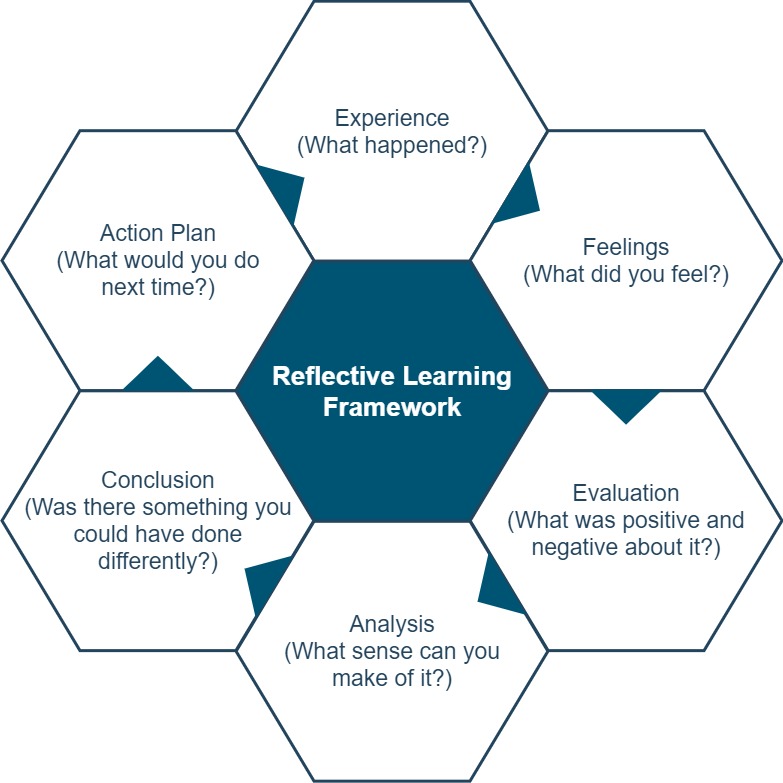
When crafting a reflection paper, you’ll want to explore a specific object, event, or idea. Keep in mind that this type of essay goes beyond merely summarizing your observations. It should include a thoughtful analysis of the topic you choose to discuss.
For example, if you’re writing a reflection paper about a theory you’ve studied, be sure to share how you learned it, any challenges you faced in understanding it, and how you plan to use the knowledge you’ve gained.
Note: Read our article – What is an essay? – to learn more about academic essays and their features in general.
Types of Reflective Essays
Not all reflective essays are the same. Depending on your course, instructor, or goal, you may be asked to write one of several distinct types:
| Type | Focus | Common in |
|---|---|---|
| Personal reflective essay | A significant life event and what you learned from it | English composition, high school |
| Academic reflective essay | Reflection on a theory, reading, or classroom experience | University courses, education programs |
| Professional reflective essay | Workplace events, professional development, skill growth | Nursing, social work, teacher training |
| Critical reflective essay | Analysis of assumptions, biases, and how they shaped your experience | Graduate-level programs |
Why Students Write Reflective Essays
Students have to learn lots of information to make use of their studies. They attend classes and other extracurricular activities to enrich their knowledge and get one step closer to their desired jobs. However, hectic schedules full of classes, other activities, and the number of assigned tasks make learners practice rote learning and cram for tests and exams. Such memorization techniques have nothing to do with thoughtful learning. As a result, you might end up being unable to apply the gained knowledge effectively.
Reflective essays aim to prevent students from mindless learning. Writing reflectively lets you review your approaches to studies and look at them from different perspectives. It also allows you to observe ideas and concepts and link them with theories learned during classes. Moreover, by writing a reflection paper, you improve your analytical thinking. It enables you to examine sources and consider various points of view when getting familiar with new ideas.
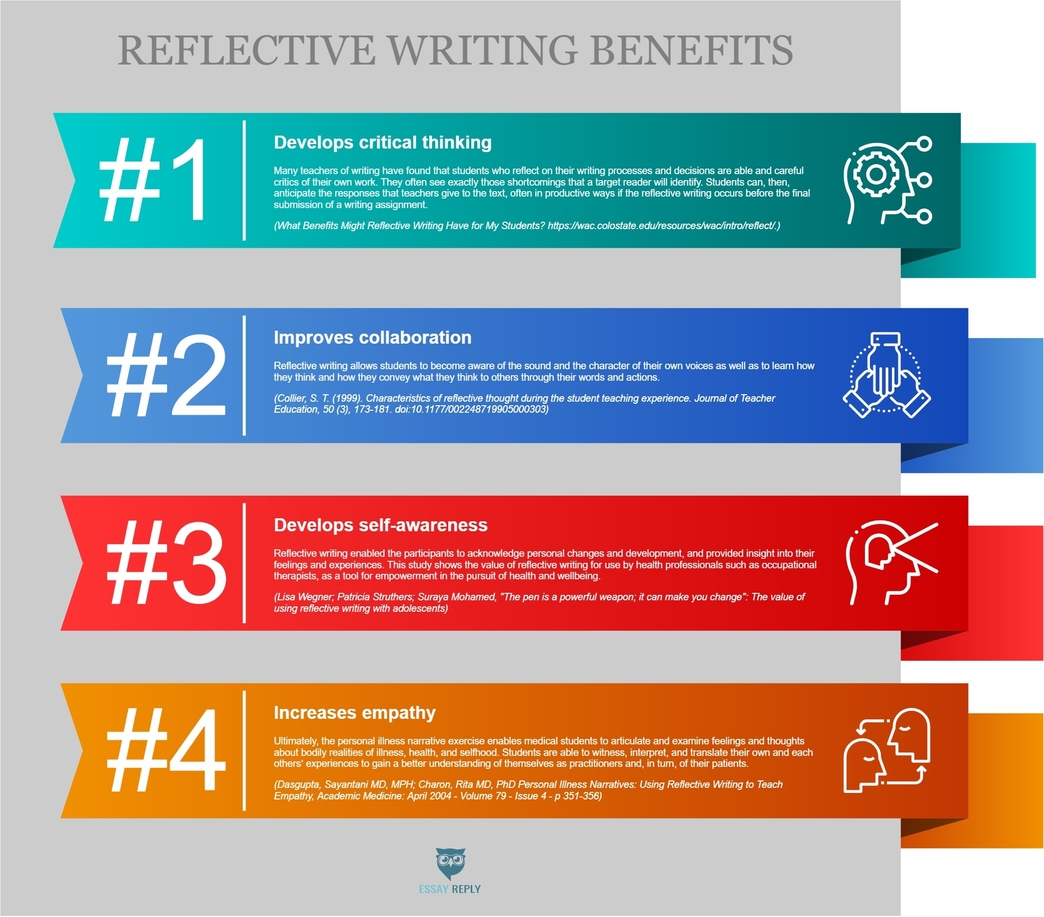
Finally, reflective essay writing is vital in developing strong critical thinking abilities. Such papers help learners approach their studying methods more critically and determine whether they are fruitful or need improvement. Also, researchers contend that systemic reflections in the form of an essay or a journal help them evaluate classroom learning and choose the most effective studying strategy.
Reflective essay writing is becoming an important element in academia, considering the spread of online education and the lack of comprehensive feedback from teachers. It might be especially helpful for students and professionals in composition, education, or health-related areas.
In short, reflective essays turn raw experiences into structured understanding. Each paper you write becomes a personal guide to your learning. When you review your experiences and put them into words, you create a record of how your thinking grows. That record helps with future decisions and professional development.
The Format of a Reflection Essay
A reflective essay must be structured appropriately and contain all the elements of an academic paper. It is always based on personal experience or learning and revolves around the three key components that make it thoughtful and coherent.
The Three Main Components of Reflection
#1: Description
The description is the first pillar of a reflection paper. It paints a picture of an event or experience and has to be concise and put in the introductory paragraph. The description should give a clear answer to what happened and what is being examined within your essay.
#2: Analysis
The analysis is the second critical part of a reflection paper. This section is the most extensive. It determines peculiarities and other essential aspects of the analyzed idea, belief, or thoughts and feelings. Particularly, the writer must explain such an experience or learning by linking it to a relevant point. Whether your reflective essay touches upon an experience (an observation) or learning (a concept you have learned), posing the following questions might help you make your analysis more rigorous:
- Why did it happen?
- What were you experiencing?
- What ideas can explain what happened?
- What did you find insightful or complicated? Does it have anything similar to what you’d experienced in the past?
- Has it influenced you? Positively or negatively?
#3: Outcome
The outcome is the ultimate attribute of a reflection paper. When writing this part, the writer encapsulates the gained knowledge, explaining its validity, usefulness, and future implications. You can also ask additional questions if you have second thoughts about the subject. Those can be:
- What did you learn?
- Suppose what you learned or observed was revealing; how different is it from what you used to think or do?
- Will you incorporate this knowledge in the future? How?
- Is the answer exhaustive, or do you need to research more to understand a theory, notion, etc.?
The Standard Academic Structure
In addition to the previously mentioned elements, a reflective essay follows the standard structure of an academic paper. It includes several key components:
- Introduction: The first paragraph states the topic and provides an overview. It has an opening sentence and describes the main idea. An introduction also includes a thesis statement, which gives a writer’s perspective on an experience, reading, or theory.
- Body: The central part usually works around the thesis, developing it and explaining what the writer has learned. Every main body section analyzes a single idea, provides a short conclusion, and transitions to the following main paragraph. The number of body paragraphs depends on the word count set by your instructor. Assuming it is a five-paragraph paper, it needs to consist of two to four main body paragraphs.
- Conclusion: The last section ends your piece of writing and voices the outcomes of the topic (an idea, concept, or reading). The writer analyzes the results, highlighting their significance, applications, and overall reactions.
Note: Read our article – How to Write an Essay – to learn more about basic essay writing techniques and components.
How to Write a Reflective Essay: Step-by-Step
Writing a strong reflective essay involves more than just recounting what happened. Follow these steps to craft a thoughtful, well-structured reflection paper:
- Choose your focus. Select a specific event, experience, theory, or reading to reflect on. The narrower and more personal your subject, the more honest and analytical your essay will be.
- Brainstorm before writing. Jot down your immediate thoughts, emotions, and reactions. Ask yourself: What happened? Why did it matter? What did I learn?
- Create an outline. Organize your reflections into the three parts — description, analysis, and outcome — before drafting anything.
- Write the introduction. Introduce your topic and end with a clear thesis that states your perspective on what you experienced or learned.
- Develop the main paragraphs. Each body paragraph should address one key aspect of your reflection. Use Gibbs’s reflective cycle or similar frameworks to stay structured: describe, feel, evaluate, analyze, conclude, and plan.
- Write the conclusion. Summarize what you learned, how it changed your thinking, and how you plan to apply that knowledge going forward.
- Revise for clarity and tone. Read your essay aloud. Replace vague language with specific, personal observations. Remove any sections that merely summarize rather than reflect.
Good reflective thesis example: “Attending the community service event changed my view of food insecurity. Before the event, I saw it as a statistic. Afterward, I understood it as a lived reality. This experience prompted me to rethink my assumptions about poverty and what practical help actually looks like.”
The reflective writing process is deeply personal. Your experiences — whether academic, professional, or everyday — are the raw material of a reflective essay. As you guide your reader through the reflection, focus on how each experience changed your understanding, challenged your assumptions, or reshaped your feelings about a subject. The quality of a reflective essay is not measured by how many events you describe, but by the depth of insight you bring to the experiences you choose.
Analysis of Reflective Paper Examples
Writing a reflective essay might be demanding. Yet, it won’t be a complex assignment if you approach it correctly. Below are several examples we are going to analyze in a broader scope. Reading them will shed light on what a well-written reflective essay should look like, what you should focus on, and how to meet the main criteria (rubric).
Good Samples
The upcoming collection of reflective essay examples comes from students studying English at Berry College. These essays showcase thoughtful reflections, each featuring vivid descriptions, insightful interpretations, and clear conclusions, which are essential elements of a reflection paper. However, it’s worthwhile to examine each one more closely to highlight its strengths.
Example 1 breakdown: The first paper kicks off with a good, informative, and compressed introduction about the writer’s reflections on the course at college. As can be seen, every paragraph has a straightforward structure. An introduction comprises an opening sentence, description, and an apt thesis statement. A body contains a topic sentence, analysis, and explanation. In turn, a conclusion wraps up critical information and provides outcomes. The essay also clearly analyzes the classes and their contents, explaining how they impacted the author. Other than that, the writer has met the final component of a reflective essay by posing relevant questions (e.g., “Have I grown as a reader and writer?”) and either answering them or expressing doubts. The essay can be considered an exemplary reflective essay.
Example 2 breakdown: The second reflection paper begins with a perfect introduction, containing an impressive vocabulary and describing the experience of majoring in English. The writer followed a great strategy by asking a rhetorical question and thus catching the audience’s curiosity, making readers continue to read the piece to find the answer. The paper then moves toward analyzing classes along with the reading activities the writer was involved in. The writer managed to provide full-fledged analyses and connect them correctly. Regarding the outcomes, they clearly and successfully finished the paper. The writer has added how they can apply acquired skills in the future, including how the teacher helped shift the writer’s paradigm and think about the upcoming classes from various angles.
Example 3 breakdown: The third essay is arguably the most academic. It includes formal vocabulary, constructions, and phrases. Besides, it has a transparent description with a powerful thesis. The entire paper is broken down into comprehensive sections, each analyzing different aspects. Notably, this reflection essay has a firm conclusion along with the outcomes of the writer’s long considerations. The author highlights that the major was an eye-opening experience; it helped the writer decide on their future career (e.g., “Thus, I’ve come to the conclusion academia is the niche for me.”) and make them apply to eight English literature Ph.D. programs. It is also essential to point out a frame structure the writer borrows from literary works. In other words, the essay starts with a question, “What is it you English majors do, precisely?” and repeats it in the end, finishing the work with a great answer.
Example 4 breakdown: The final reflection paper from the batch is equally stunning. It sparks the reader’s attention right away with a good hook – the message about being at a crossroads during the author’s sophomore year. Likewise, it contains a well-organized description of undertaken classes along with an analysis of them. The author managed to explain the importance of such courses and the challenges they encountered along the way. For instance, the writer talks about ENG 495, a class on Writing about Place. The first work didn’t end up being the one that the writer expected to see. Yet, this inspired them to work harder on the language and make it less eloquent, lifting, and occasionally overwhelming.
A Sample That Needs Some Improvement
The second sample features a reflective essay, likely crafted by a high school student who aspires to join a business, marketing, or public relations program. This essay effectively captures the essence of their senior project, highlighting key insights, what they found most exciting and valuable, as well as the results, including successes and areas for improvement.
However, it doesn’t seem to be fully coherent. Although the reflection paper is broken down into them, they sometimes fail to bridge the main idea. For instance, the second section about past activities does not fit the other paragraphs well. It would be best to include the following phrases to strengthen the connection between units and increase the piece’s readability:
- For me, the most critical/useful/valuable
- At first, Initially, Subsequently, I thought/felt/knew
- This might be/is probably because of/related to/explained by
Apart from that, the last section looks clumsy and doesn’t fit the context that well. It doesn’t provide a conclusion to the paper. Neither does it answer the required list of questions from the above. This essay lacks unity and fails to meet all the characteristics of a reflection paper. To sum up, unlike the mentioned examples, this work doesn’t entirely fall into a good reflective essay because of vague transitions and paragraphs with redundant information.
Final Tips on Writing Reflective Essays
A reflective essay is a type of paper that utilizes analytical thinking. That’s why it is crucial to remain focused and attentive to detail when reflecting on specific essay topics. The following is the list of recommendations to help you compose an effective reflective essay.
Do’s
- Shape your structure: Academic essay writing involves following a certain structure and formatting style. Unlike a diary entry, it cannot be a free flow of your thoughts. Make sure your reflective essay has an apparent introduction, body, and conclusion sections.
- Make use of your notes: Relying on class notes can help you write a reflective paper. Specifically, it will speed up the writing process, make the paper pertinent to your curriculum, and save time looking for scholarly sources.
- Analyze your content: Many students confuse reflection essay writing with a narrative, describing their personal experience and thus scratching the surface only. Ensure analyzing what happened, why it happened, and what you learned from it.
- Use reflective questions: To improve your analysis, ask yourself a set of specific questions related to the topic. For instance, when writing about theoretical material, you can ask yourself, “How did it change my life?”, “How else can I apply this to my life?”, “What knowledge did I gain?”, “Does it make me more competent?” etc.
Don’t’s
- Don’t use informal language: Although you need to speak from your point of view and use phrases, like I reckon, In my opinion, I believe, and so forth, there are still limitations. Avoid colloquial language, idioms, and other phrases that can negatively influence your piece, making it biased and overly subjective.
- Don’t exaggerate with descriptions: Whatever your topic, you need to describe it in the introductory paragraph. However, keep in mind that your task is to reflect on something. Therefore, keep the description short and clear.
- Don’t just recount what you experienced: Without a deep analysis, your reflective essay will turn out to be a book report or a simple story. You should not only narrate or describe but also analyze and draw conclusions.
- Don’t start without an outline: You risk failing overall unity and readability when writing a reflective essay without an outline. Furthermore, you will spend more time working on your piece. Create an essay outline before writing a reflective paper.
Was this article helpful?

Written by
Terry is a Chicago-based writer and editor who creates practical, student-friendly guides on essay writing, research, and citation styles (APA, MLA, and Chicago). He’s spent 15+ years editing educational content and building clear examples that help readers apply rules without guessing. When he’s not revising drafts, he’s usually turning messy notes into clean outlines and hunting down the one detail everyone skips.